
Gradually, then suddenly
Jemima Peppel-Srebrny is a Senior Economist at the European Stability Mechanism
The summer of 2026 gave Europe two warnings: it was the hottest on record, and its government bonds sold off. The timing was a coincidence, but with every flood or heatwave that the state has to pay for, climate risk turns into sovereign risk and surfaces – gradually, then perhaps suddenly – on the government balance sheet. In this column, I argue that adaptation can square the circle: it reduces the expected losses that physical climate risk imposes on the sovereign balance sheet, and with them both climate and sovereign risk.
Even as climate change continues mostly unabated, Europe is adapting only slowly (EEA 2024). One reason is that the fiscal return to adaptation is rarely calculated explicitly. Another is that fiscal space is tight, so investing in climate resilience competes with expenditure needs that either appear more existential (defence) or have more vocal support. Recognising the fiscal value of climate resilience would help1.
Physical climate risk weighs on both sides of the sovereign balance sheet
The human and economic costs of extreme weather events – such as heatwaves, floods, storms and wildfires – are already large and will grow as temperatures rise further2. Adaptation is investment in avoiding future damage. Because its value lies in a counterfactual, the economic, social and fiscal benefits of adaptation are hard to see: finance ministers, bond investors and voters notice the flood that did happen, rather than how much worse it might have been without the dyke. But the value of this counterfactual is real and can be estimated, even if with wide confidence bands.
Natural disasters cause direct damage as well as an indirect macroeconomic cost in terms of lost output. The share of direct damage borne by the government is the direct fiscal cost of physical climate risk; lost output adds to it3. When these events happen, the resulting cost falls on both sides of the sovereign balance sheet and lowers government net worth (total assets less total liabilities). Disasters destroy public assets – roads, bridges, schools – that have to be rebuilt. Governments also step in with relief for, and bailouts of, uninsured households, firms or banks. Physical climate risk thus creates an implicit contingent liability on the sovereign balance sheet, which materialises only once a disaster occurs4.
Treating adaptation simply as expenditure will lead governments to invest too little. Recognising what adaptation adds to expected government net worth could change that
Adaptation makes fiscal sense
Fiscal rules treat adaptation the way Oscar Wilde’s cynic treats everything: they know its price, but not its value. Through the cash-flow lens of budgets and fiscal rules, adaptation is an outlay: it adds to spending – and, depending on how that spending is financed, to debt – today.
However, through the balance-sheet lens, it swaps cash for a public asset – a dyke, say – so the government’s net worth does not change at first. Over time, by reducing exposure and vulnerability to climate hazards, adaptation lowers expected losses on both sides of the sovereign balance sheet: damage to public assets as well as what the state has to pay when disasters do occur. The size of this reduction is the fiscal value of climate resilience. Where this value exceeds its cost, adaptation raises the government’s expected net worth5.
A simple calculation (Figure 1) shows that flood defences are likely to strengthen the sovereign balance sheet: indicatively, each euro spent on adaptation could avoid more than €4 of flood damage to society over the rest of the century, saving the government about €3. These estimates leave out other extreme weather events, indirect macroeconomic costs and tail risks, all of which would raise the (fiscal) pay-off6.
Nonetheless, they suggest that treating adaptation simply as expenditure will lead governments to invest too little. Recognising what adaptation adds to expected government net worth could change that.
Figure 1. The fiscal and societal returns to each euro spent on flood adaptation7
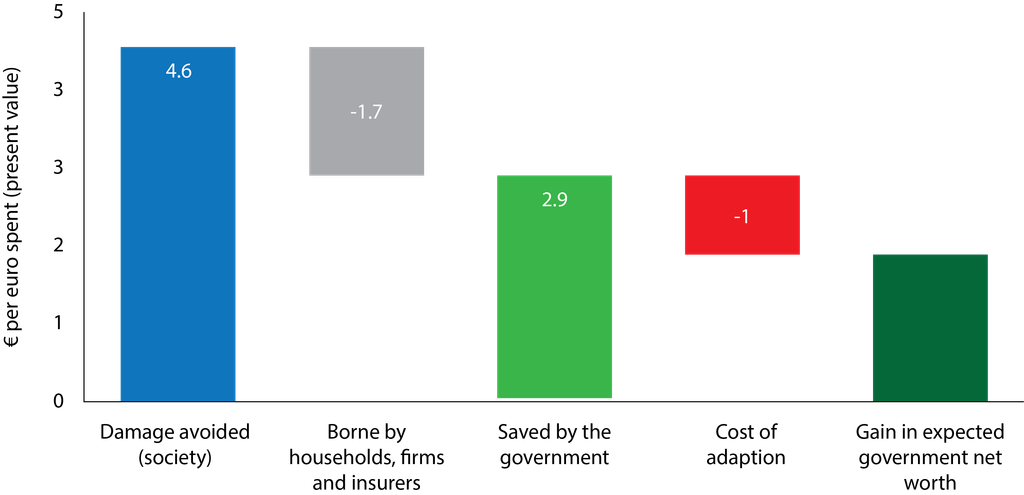
Notes: All values are per euro spent on flood defences in the euro area, so the cost is €1 by construction. Present value over 2020-2100 of the direct damage avoided. Assumes a 64% government share.
Sources: Dottori et al (2022); Vousdoukas et al (2020); World Bank and European Commission (2021); own calculations.
Let climate resilience count for sovereign risk
Flood risk matters for euro area sovereign balance sheets: estimates based on JRC data suggest that river and coastal floods alone could impose an expected cost of about 2% of GDP (€320 billion at today’s GDP) cumulatively over the next 25 years, without considering tail risks, flash floods, and indirect macroeconomic effects8.
Retention areas, stronger dykes and higher sea walls would cost about €4 billion a year – roughly a third of what these floods are expected to cost governments each year over this period. By 2100, they would reduce flood damage by 80-90%. Adaptation would thus benefit society, the economy and the sovereign balance sheet.
But the tools used in fiscal decision-making largely ignore these benefits9. Debt sustainability assessments, fiscal-risk statements and sovereign stress tests could quantify expected losses from physical climate risk and assess how credible adaptation measures might reduce them. The benefits of adaptation would then show up in debt projections, rather than as an exemption from fiscal rules.
Beyond lowering expected costs, adaptation limits the (fiscal) cost of tail events – the low-probability, high-cost disasters that are particularly relevant from a sovereign-risk perspective (Preinfalk et al 2026). Existing evidence suggests that climate shocks raise borrowing costs more in high-debt countries (Anyfantaki et al 2025). Adaptation may thus matter most for those countries with least room to absorb additional shocks, and the least fiscal space to finance adaptation themselves.
Estimating what physical climate risk is expected to cost the sovereign balance sheet – and hence what adaptation would save – turns adaptation into a visibly worthwhile investment. The Ahr floods of 2021 caused direct damage worth about 0.8% of Germany’s GDP, floods in 2023 more than 11% of Slovenia’s, and the Valencia floods of 2024 about 1.1% of Spain’s (Grabbe et al 2026).
One such event in a highly indebted country, or several in quick succession in a smaller one, could be how ‘gradual’ becomes ‘sudden’. Governments that recognise the fiscal value of climate resilience – and invest in adaptation – can keep ‘sudden’ small while protecting livelihoods.
Endnotes
1. The Commission’s new EU Framework for Climate Resilience calls for the same shift: from seeing adaptation “as a short-term cost” to perceiving it “as an investment made to avoid higher costs and losses in the long-term” (European Commission 2026b).
2. Losses from extreme weather events in the EU averaged €45 billion a year in 2020-2024, more than twice the 2010-2019 average (EEA 2025).
3. Through lower tax revenue, higher spending on automatic stabilisers and discretionary support to hard-hit sectors.
4. Governments are not legally obliged to provide relief or bailouts but usually do; hence the fiscal-risk literature calls this liability ‘implicit’ (OECD and World Bank 2019). Explicit contingent liabilities, such as state guarantees of catastrophe insurance, are generally not recorded on balance sheets but should be disclosed under EU rules; France, for example, quantifies its guarantee of the natural catastrophe insurance scheme every year (OECD and World Bank 2019). Expected future spending on relief and reconstruction does not appear on government balance sheets; some governments discuss it in fiscal-risk statements (e.g. New Zealand Treasury 2026), but in the EU such reporting is still at an early stage (Salmon-Genel 2025). Most of the expected loss estimated here is of this kind.
5. Similarly, a bank that lowers the risk in its loan book needs less capital (Basel Framework). Fiscal rules, by contrast, focus on deficits and debt, so they count only the cost of adaptation, upfront. Accrual accounts would record a dyke as an asset, but at its cost, not at the losses it avoids. Other adaptation spending, such as grants to flood-proof homes or early warning systems, is harder to record as an asset.
6. Preinfalk et al (2026) find that Dutch flood protection, a net fiscal cost in an average year, strongly protects the budget in a 1-in-500-year flood. The Commission’s impact assessment concludes that governments weighing adaptation against expected annual costs alone underinvest (European Commission 2026b). Floods account for 47% of recorded losses from extreme weather events (1980-2024; EEA 2025).
7. The calculation uses estimates of river (for 1.5°C and 2°C) and coastal flood damage (under RCP 4.5) in the euro area, and of the most cost-effective defences against these floods (designed for 3°C by 2100; mainly retention areas and stronger dykes along rivers and higher sea walls along built-up coasts; Dottori et al 2022; Vousdoukas et al 2020). Most of the damage avoided comes late in the century: without defences, flood damage would rise to about 1% of GDP a year by 2100. Global warming is assumed to follow the warming path of the proposed European Climate Resilience Law: 1.5°C by 2030, 2°C by 2050 and 3°C by 2100 (European Commission 2026b). As in the JRC studies, costs and damage avoided are discounted at 3% a year (5% in lower-income Member States). Governments bear 35-64% of flood and earthquake losses in the EU (World Bank and European Commission 2021); as this range excludes support to businesses, the upper end of the range is used. At 35%, each euro invested would still save the government about €1.60.
8. Existing estimates put direct river and coastal flood damage in the euro area at 0.09% of GDP per year at 1.5°C of warming, and at 0.16% at 2°C (Dottori et al 2022; Vousdoukas et al 2020). With a 64% government share (World Bank and European Commission 2021), that amounts to 0.06% and 0.10% of GDP a year, respectively, for the government. Over 2026-2050, as warming rises from 1.5°C to 2°C, this adds up to about 2% of GDP (cumulative cost; €320 billion at 2025 GDP). The defences would cost about 0.03% of GDP a year on average over 2020-2100, and by 2100 would cut river flood damage by about 80% and coastal flood damage by about 90%.
9. The OECD and World Bank (2019) note that fiscal frameworks count the cost of adaptation but not its benefits; Zenios (2022) argues that budgetary plans should include climate damages and the costs of mitigation and adaptation, potentially as contingent liabilities. EU rules now ask governments to report disaster-related contingent liabilities (Council Directive (EU) 2024/1265 of 29 April 2024 amending Directive 2011/85/EU on requirements for budgetary frameworks of the Member States), and the proposed European Climate Resilience Law would track them across the EU (European Commission 2026b). The Commission’s debt sustainability assessment now includes climate scenarios, but leaves out the direct costs of disasters and assumes static adaptation, so it does not show what adaptation saves (European Commission, 2026a; Gagliardi 2026). On why both sides of the balance sheet matter for sovereign risk, see Peppel-Srebrny (2024).
References
Anyfantaki, S, M Blix Grimaldi, C Madeira, S Malovaná and G Papadopoulos (2025), “Decoding climate-related risks in sovereign bond pricing: a global perspective”, ECB Working Paper 3135.
Dottori, F, L Mentaschi, A Bianchi, L Alfieri and L Feyen (2022), “Flood impacts and adaptation strategies under future scenarios”, European Commission, Joint Research Centre.
Dottori, F, L Mentaschi, A Bianchi, L Alfieri and L Feyen 2023), “Cost-effective adaptation strategies to rising river flood risk in Europe”, Nature Climate Change 13: 196-202.
EEA – European Environment Agency (2024), European Climate Risk Assessment, EEA Report 01/2024.
EEA (2025), “Economic losses from weather- and climate-related extremes in Europe”, indicator, October.
European Commission (2026a), Debt Sustainability Monitor 2025, European Economy Institutional Paper 332, Directorate-General for Economic and Financial Affairs, February 2026.
European Commission (2026b), “EU Framework for Climate Resilience: A resilient Europe for a changing climate”, COM(2026) 720, October.
Gagliardi, N (2026), “Europe’s public finances in a warming world”, VoxEU.org, 5 February 2026.
Grabbe, H, U Keliauskaitė, M-S Lappe, I Monasterolo, M Tavoni and G Zachmann (2026), “Planning for the rising fiscal costs of climate disasters”, Bruegel Policy Brief 13/2026.
New Zealand Treasury (2026), Pre-election Economic and Fiscal Update 2026, 29 September.
OECD and World Bank (2019), Fiscal Resilience to Natural Disasters: Lessons from Country Experiences, OECD Publishing.
Peppel-Srebrny, J (2024), “Hello from the Other Side: Both Government Liabilities and Assets Matter for Sovereign Risk”, Journal of Money, Credit and Banking 56: 1595-1604.
Preinfalk, E, N Knittel, B Bednar-Friedl, G Bachner, E Sainz de Murieta and M Tesselaar (2026), “Fiscal implications of public climate change adaptation: An analysis of three European countries”, Ecological Economics 243, 108915.
Salmon-Genel, M (2025), “Assessing the Macro-Fiscal Risks from Climate Change: Concepts, Methodological Approaches, and Insights from Country Practices”, European Economy Discussion Paper 224.
Vousdoukas, MI, L Mentaschi, I Mongelli, J-C Ciscar, J Hinkel, PJ Ward, S Gosling and L Feyen (2020), Adapting to rising coastal flood risk in the EU under climate change, JRC Technical Report EUR 29969 EN, Publications Office of the European Union.
World Bank and European Commission (2021), Financial Risk and Opportunities to Build Resilience in Europe.
Zenios, S (2022), “Climate change risks to sovereign debt: How integrated assessment models inform our understanding”, VoxEU.org, 13 July 2022.
Author’s note: I would like to thank Dag Detter and Ian Ball for helpful comments. Any errors or omissions remain my own. This article was originally published on VoxEU.org.