

Europe’s corporate tax trilemma
Madalena Barata da Rocha, Roel Dom, Pascal Saint-Amans and Bo Sangers
Executive summary
The European Union’s implementation of global anti-tax avoidance rules and the global minimum tax is widely regarded as a success. By substantially reducing opportunities for profit shifting, these reforms have strengthened revenue protection. But this success also has an underappreciated implication for the EU.
Profit shifting in part emerged as a response to differences in national corporate tax systems. It resulted in multinational firms reducing the effective tax burden associated with investing in higher-tax EU countries. It thus both eroded tax bases and offset the influence of tax differences on real investment decisions.
By constraining this form of ‘self-help’ while leaving the underlying diversity of national corporate tax systems largely intact, anti-avoidance reforms potentially increase the sensitivity of investment to tax differentials across the EU. Evidence shows that investment has become significantly more responsive to effective corporate tax rates in the last decade since coordinated anti-avoidance rules started to be discussed.
Reforms to tackle profit shifting have thus shifted the trade-off facing European policymakers to a trilemma involving tax sovereignty, revenue protection and investment neutrality. In this context – though not questioning the merits of combatting profit shifting – the success of anti-avoidance reforms strengthens the economic case for further coordination of corporate taxation within the single market, as anti-avoidance policy and tax harmonisation become increasingly complementary.
1 Introduction
A tension lies at the heart of the European Union’s single market. Goods, services, capital and people move freely across borders, but corporate taxation remains organised largely along national lines. For companies, this creates complexity and ambiguity, increasing tax compliance costs, but also opportunities for tax avoidance, encouraging tax competition and distorting the allocation of investment.
Policymakers and academics have spent decades debating whether tax harmonisation could promote greater economic integration1, yet progress towards harmonisation has been limited. Corporate taxation remains largely a national competence and EU-level tax initiatives have stalled repeatedly. Rather than reducing these differences directly through harmonisation, EU tax policy has thus focused increasingly on limiting the opportunities divergence creates for profit shifting from high to low-tax countries. In particular, over the last decade, reforms inspired by the Organisation for Economic Co-operation and Development/G20 Base Erosion and Profit Shifting (BEPS) project2, culminating in the implementation of a minimum tax on the profits of large multinationals (known as Pillar Two), have substantially reduced opportunities for profit shifting.
Most analyses of profit shifting focus on revenue losses and fairness concerns. The BEPS reforms are considered a success because they help countries safeguard their tax revenues (eg. Contreras et al 2026). But these reforms also have an underappreciated consequence for economic efficiency. In a fragmented tax environment such as the EU, profit shifting reduces the extent to which investment decisions are driven by tax considerations rather than economic fundamentals.
The success of anti-avoidance reforms has therefore weakened a mechanism that allowed multinational firms to offset and reduce the effective tax burden associated with investing in higher-tax EU countries. Consequently, the economic importance of tax differentials between jurisdictions has increased again.
This changes the trade-offs facing European tax policy. A trilemma between tax sovereignty, revenue protection and investment neutrality has emerged. In the trilemma, if the goal for the EU is to combine revenue protection with economic efficiency, the price is a reduction in tax sovereignty: member states would need to accept greater convergence in tax rates and bases to prevent tax differentials from distorting investment. If, instead, tax sovereignty is to be preserved alongside revenue protection, economic efficiency will remain weakened.
Note, the argument is not that profit shifting should be tolerated. The adverse consequences it creates are real and the progress achieved through international tax cooperation should not be reversed. Rather, the consequence for the EU of progress on BEPS is that economic benefits of further tax harmonisation have increased. The success of anti-avoidance strengthens the case for continuing efforts to reduce differences in tax systems and to promote a more integrated corporate tax framework within the single market.
In this respect, the global minimum tax may offer more than a revenue floor: the common tax base it has already established for large multinational groups could itself serve as a building block for broader harmonisation, reducing the technical burden of constructing a unified EU corporate tax framework from scratch.
This Policy Brief proceeds in four steps. Section 2 briefly sets out the EU corporate tax framework, focusing on the contrast between limited harmonisation and the more successful implementation of common anti-avoidance rules. Section 3 develops the paper’s central argument that restricting profit shifting can increase the sensitivity of real investment to corporate tax differentials and presents evidence from the EU single market alongside supporting evidence from other jurisdictions. Section 4 draws out the resulting policy trade-off between tax sovereignty, revenue protection and investment neutrality. Section 5 considers the implications for EU tax policy and sets out options for moving towards a more coherent balance between these objectives.
2 The EU corporate tax landscape
The EU has advanced substantially on coordinated anti-avoidance while leaving the underlying diversity of national corporate tax systems largely intact. This section briefly reviews both, since the interaction between them underpins the argument that follows.
2.1 Persistent fragmentation and limited positive harmonisation
Corporate income taxation across the EU is fragmented as it remains a national competence. EU legislation on direct taxation (ie. positive harmonisation)3 requires unanimity in the Council of the EU under Article 115 TFEU, meaning any EU country can veto a proposal4.
This is not without consequence as political preferences diverge: smaller, open economies tend to use competitive tax rates as instruments of their growth strategies, while larger economies with substantial domestic markets have less to gain from tax competition and more to lose from base erosion. Accordingly, they tend to favour harmonisation.
Tax systems are, moreover, deeply embedded in national social contracts, reflecting genuine differences in democratic preferences on how governments finance public services and redistribute income. As a result, ambitious EU proposals to harmonise to some degree corporate taxation have stalled repeatedly5. Progress has been confined to narrow directives that dismantle specific obstacles to crossborder activity.
These include the 2011 Parent-Subsidiary Directive (Council Directive 2011/96/EU), which eliminates double taxation of profits distributed between related companies in different member states, the 2009 Merger Directive (Council Directive 2009/133/EC – removes fiscal obstacles in crossborder reorganisations), the 2003 Interest and Royalties Directive (Council Directive 2003/49/EC – removed source taxation on intra-group interest and royalty payments), and the FASTER Directive of 2025 (Council Directive (EU) 2025/50 – seeks to simplify and accelerate withholding-tax relief procedures for crossborder investors).
2.2 Negative harmonisation and its limits
Judicial integration has gone further. The Court of Justice of the EU (CJEU) polices national tax rules in the context of the fundamental freedoms of the internal market, particularly the freedom of establishment and the free movement of capital. The CJEU has struck down measures that discriminate against crossborder activity.
But this ‘negative’ harmonisation cuts both ways. Because national tax measures that restrict free movement have traditionally been justified only in cases of “wholly artificial arrangements” (see Box 1), the ability of EU countries to defend their tax bases against intra-EU profit shifting has been constrained.
The 2006 Cadbury Schweppes ruling on the United Kingdom’s controlled-foreign-company (CFC) rules provides a particularly clear illustration: EU countries may not apply CFC rules to subsidiaries that carry out real economic activity in other member states, even where those subsidiaries benefit from substantially lower tax rates (Box 1).
More recent case law suggests that the Court has become somewhat more permissive of abstract and general anti-abuse measures (Weber and Wattel 2025), but the underlying tension between market integration and base protection remains. Because the legislative route is so heavily obstructed, much of the work of integration has fallen instead to the CJEU.
Box 1. The Cadbury Schweppes ruling6
Cadbury Schweppes concerned the United Kingdom’s controlled-foreign-company (CFC) rules, under which the UK tax authorities included the profits of subsidiaries established in low-tax jurisdictions (in this case, Ireland) in the tax base of resident parent companies. The objective was to prevent profit shifting and tax avoidance.
The CJEU held that such rules restrict the freedom of establishment and may only be justified where they target “wholly artificial arrangements”, defined as subsidiaries lacking real substance and established solely for tax purposes. A genuine establishment (ie. one with real staff, premises and activity) therefore falls within the protection of the freedom of establishment; the mere fact that it benefits from a lower-tax regime does not make it a wholly artificial arrangement.
Consequently, EU countries may not apply CFC rules to subsidiaries established in other member states where those subsidiaries carry out real economic activities. This limits the ability of member states to tax profits shifted to lower-tax jurisdictions within the EU, while an equivalent domestic structure would have its profits taxed at the full national rate.
2.3 Combatting base erosion and profit shifting (BEPS)
The corporate tax divergences that remain in place in the EU are not costless. They create opportunities for tax avoidance and incentivise tax competition. Reported profits are highly sensitive to tax-rate differences and are disproportionately booked in lower-tax member states (Huizinga and Laeven 2008; Beer et al 2018), with the resulting losses falling on higher-tax countries and flowing largely to other EU members (Nerudová et al 2023) (Figure 1).
Such competition has in turn pressed corporate tax rates downward, from above 40 percent in the mid-1980s to about 20–25 percent today, as EU countries adjust strategically to one another (Devereux et al 2008; Overesch and Rincke 2009).
Figure 1. Corporate tax revenue lost to other jurisdictions due to profit shifting (% of GDP), 2022
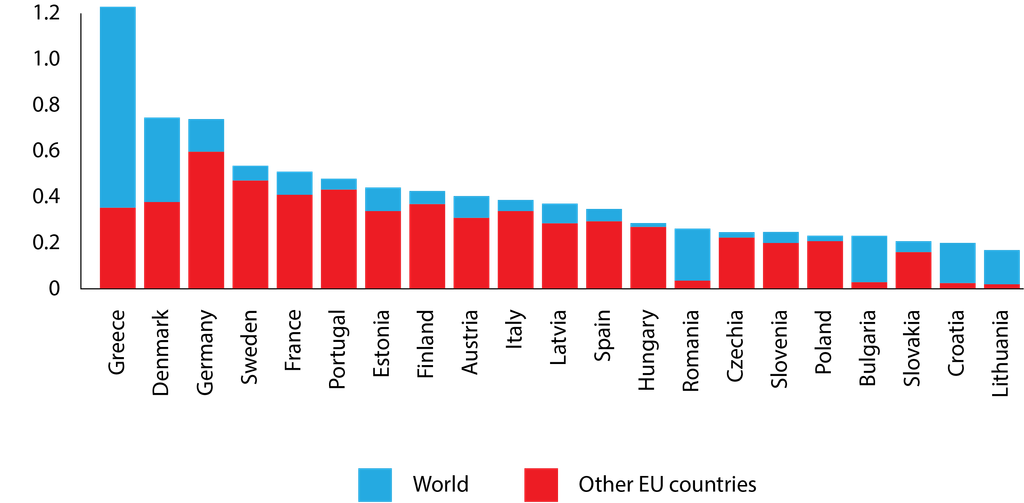
Note: revenue winners are not shown; these are Ireland, Netherlands, Luxembourg, Belgium, Malta and Cyprus.
Source: Bruegel based on the Atlas of Offshore World, EU Tax Observatory, and on World Bank GDP data.
In response, and in the wake of the 2008–2010 global financial crisis, when global revenue losses were estimated at $100 billion to $240 billion per year, the G20 and the OECD started the Base Erosion and Profit Shifting (BEPS) project in 2013 (OECD 2013; OECD 2015). EU countries, along with other BEPS members, have written common these standards into national law to limit international tax avoidance. The EU has given effect to this agenda through three main instruments.
The 2016 Anti-Tax Avoidance Directive (ATAD, Council Directive (EU) 2016/1164), extended in 2017 by ATAD II (Council Directive (EU) 2017/952) established common minimum standards on interest deductibility, exit taxation, a general anti-abuse rule, hybrid mismatches and a CFC regime that attenuates the tension described in Box 1. As a minimum-standards instrument, it constrains avoidance without displacing national systems.
The Directive on Administrative Cooperation (DAC, Council Directive 2011/16/EU), originally adopted in 2011 and amended many times since, has built an increasingly comprehensive system of automatic information exchange between national tax authorities, attacking avoidance through transparency7.
The 2022 Minimum Tax Directive (Council Directive (EU) 2022/2523) occupies a somewhat special position. It transposed Pillar Two of the OECD/G20 global agreement into EU law, obliging member states to levy a top-up tax that ensures an effective rate of at least 15 percent on large multinational groups (those with consolidated revenues above €750 million)8.
By prescribing a minimum tax, Pillar Two blunts the advantage of shifting profits to low-tax jurisdictions and so targets tax competition itself. It leaves the broader diversity of national corporate tax systems intact. As such, it represents a significant, but partial, step towards corporate tax harmonisation.
The EU unanimity requirement on tax rules did not prevent agreement on ATAD, DAC or the minimum tax. Several factors account for the contrast. Anti-avoidance measures protect national tax bases rather than surrender them, so they align with the revenue interests of larger EU countries; they built on an externally negotiated OECD consensus, which lowered the political cost of agreement and made resistance harder to justify; and even lower-tax states could accept a global minimum that bound their competitors as much as themselves.
The contrast between substantial EU progress on anti-avoidance and comparatively little progress on structural harmonisation matters because profit shifting and tax fragmentation are not independent phenomena. The former emerged, at least in part, as a response to the latter. Understanding how these two features interact is therefore essential to assess the broader consequences of anti-avoidance reforms.
3 The overlooked efficiency channel of profit shifting: loss of self-help
Standard analyses of profit shifting focus on its costs: it distorts profit allocation away from where economic activity takes place, erodes member state tax bases, generates costly planning structures that serve no productive purpose and creates competitive inequities between domestic firms (which cannot shift profits) and multinationals (which can). These distortions are real and well-documented. Globally, multinationals are estimated to shift a significant share of their profits to low-tax jurisdictions, at substantial cost to public revenues (Hines 2010; Tørsløv et al 2023; Guvenen et al 2022).
Yet this standard framing overlooks a less visible channel through which profit shifting interacts with real economic activity. By reducing the effective tax burden on investment in high-tax jurisdictions, profit shifting can offset to some degree the investment distortions that arise from tax differentials. In the EU, with 27 different statutory tax rates and a wide range of tax incentives, profit shifting has dampened the sensitivity of real investment to statutory tax differentials. Removing that ability to profit shift without addressing the underlying tax diversity may therefore increase the sensitivity of investment to tax differentials.
3.1 The investment channel: theory
The academic literature increasingly recognises that profit-shifting opportunities weaken the link between statutory corporate tax rates and real investment decisions (Dharmapala 2008; Hong and Smart 2010; Klemm and Liu 2019; Mongrain et al 2023). When multinationals can reallocate taxable profits across jurisdictions, the effective tax burden associated with investing in a high-tax country is reduced. Profit shifting thus lowers the effective cost of capital and can stimulate real investment even in relatively high-tax jurisdictions. The implication is that tax differentials exert a weaker influence on capital allocation when profit shifting is feasible, compared to when profit-shifting is not available.
Lax anti-avoidance regulation then functions as a substitute for statutory tax rate cuts by reducing the cost of capital for multinational firms. EU countries that tolerate profit shifting effectively operate corporate tax rates for multinationals that are below their headline rates.
Constraining profit shifting therefore changes the competitive equilibrium not only in terms of reported profits but also in terms of real investment incentives. Without compensating adjustments to rates or bases, anti-avoidance reform can therefore raise the effective tax burden on mobile investment, restoring the importance of tax differentials as a driver of location decisions.
3.2 Evidence from the EU single market and other jurisdictions
Intra-EU foreign direct investment data supports this supposition. Intra-EU FDI became measurably more tax-sensitive after the announcement of the BEPS initiative in 2015 (Figure 2). Before 2015, a one-percentage-point increase in the host-country effective average tax rate (EATR) was associated with an approximately eight percent decline in bilateral FDI flows. Since 2015, the same one-point increase has been associated with a 14 percent decline.
Put differently, a given cross-country tax differential has exerted roughly 75 percent more influence over the location of real investment within the single market post-2015. This is consistent with profit-shifting constraints restoring the link between statutory tax burdens and genuine investment location decisions.
Figure 2. Sensitivity of FDI flows to effective tax rates, before and after BEPS

Notes: bars show the total implied effect of the EATR on inverse hyperbolic sine transformation of bilateral FDI flows (2013-2024). See the appendix for methodological details. Five non-OECD EU members (Bulgaria, Croatia, Cyprus, Malta and Romania) appear only as source countries.
Source: Bruegel.
Cross-country evidence supports the evidence shown in Figure 2. Buettner et al (2018), using a worldwide panel of multinational affiliates, found that introducing or tightening a thin-capitalisation rule increased the tax-rate sensitivity of FDI in high-tax host countries. De Mooij and Liu (2021) corroborated this on the real investment margin.
Exploiting variation in the tightness of thin-capitalisation safe-haven ratios across 34 countries between 2006 and 2014, they found that tighter rules significantly reduced real capital accumulation by affected multinationals, with the adverse effect increasing in line with the strictness of the rule and the level of the host-country tax rate.
Evidence from case studies further supports this pattern. In a study of the impact of the repeal of Section 936 of the US Internal Revenue Code – a provision that allowed US multinationals to shift profits to Puerto Rican affiliates – Suárez Serrato (2018) found that eliminating this shifting channel raised the effective tax cost of domestic investment, with measurable real consequences.
Affected firms substantially reduced domestic investment and domestic employment. The effects were amplified at the local level, with labour markets exposed to profit-shifting firms experiencing declines in wages, employment and property values, while reliance on government transfers increased.
A closer analogue to the EU experience comes from Bilicka et al (2022) exploited the United Kingdom’s 2010 Worldwide Debt Cap (an anti-avoidance rule limiting interest deductibility relative to a firm’s global debt) as a quasi-natural experiment. Affected multinationals reduced their UK debt and increased debt held in foreign affiliates, but critically also reallocated some of their real operations away from the UK. This showed that anti-avoidance reforms do not simply curtail paper profit shifting but can trigger real activity relocation, with direct consequences for domestic investment and employment.
Bilicka et al (2024) provided some of the most direct structural evidence on the investment consequences of restricting profit shifting. Based on UK administrative tax return data, they found that a one percentage point rise in the host-country corporate tax rate reduces capital accumulation by 0.8 percent when profit shifting is available, but by 1.8 percent in its absence. In other words, profit shifting dampens the investment sensitivity of multinationals to tax rate changes by more than half.
To be clear: none of this implies that profit shifting should be tolerated. The argument is narrower. In the fiscally fragmented EU environment, profit shifting made multinationals less sensitive to tax differentials, functioning as an imperfect substitute for the tax harmonisation that political constraints have so far prevented.
Anti-avoidance reforms have changed that. Access to consumers, labour quality, infrastructure, legal certainty and other market fundamentals continue to anchor investment decisions, and the EU single market remains competitive in these respects. But at the margin, tightening of anti-avoidance rules has increased the importance of remaining tax differentials across EU countries.
4 The emerging trilemma
Debates on European corporate taxation have long been framed as a tension between tax sovereignty and economic efficiency (the latter understood here simply as investment neutrality)9. Greater tax harmonisation would reduce tax-induced distortions within the single market but would constrain the ability of member states to design their own tax systems.
Preserving national sovereignty, conversely, implies differences in tax rates and bases that distort the location of investment. This framing, however, is incomplete. Recent developments suggest that a third objective – revenue protection – must be brought into the picture. The interaction between all three generates a trilemma: no configuration secures all three at once.
Tax sovereignty sits at the apex of the trilemma (Figure 3), with revenue protection and economic efficiency at the two base corners. The trade-offs between them are real. Preserving tax sovereignty (ie. the ability of EU countries to set their own rates, define their own bases and deploy taxation as an instrument of economic policy) produces the kind of differentiation that distorts multinationals’ investment decisions and creates incentives to shift profits across borders.
Pursuing revenue protection constrains those profit-shifting opportunities but also dampens the mechanism that enables multinationals to reduce the effective tax burden associated with investing in higher-tax EU countries, increasing the tax sensitivity of investment.
Finally, moving to location-neutral investment allocation requires member states to surrender some of the fiscal autonomy through which national preferences over the tax-and-spend mix are expressed.
Figure 3. An emerging trilemma

Source: Bruegel.
The pre-BEPS equilibrium occupied a position towards the right of the triangle, closer to investment neutrality and tax sovereignty, but at a cost to revenue protection. The negative harmonisation achieved through the CJEU reinforced this dynamic: rulings such as Cadbury Schweppes (Box 1) constrained EU countries from applying CFC rules to subsidiaries with genuine economic substance, limiting their ability to tax profits shifted to lower-tax jurisdictions within the EU.
Profits were systematically booked away from where economic activity occurred, with the tax revenue losses falling on higher-tax countries. But this system meant firms could make real investments in those high-tax countries that may not have been worthwhile in the absence of profit shifting.
The BEPS reforms from 2015 on have shifted the equilibrium towards the revenue protection side. BEPS-linked EU policy measures such as ATAD and DAC have achieved what structural tax harmonisation attempts have failed to deliver: binding, enforceable common rules that have substantially curtailed profit-shifting opportunities across the single market. But this comes at a cost to economic efficiency, making capital flows more sensitive to tax differentials again (section 3), meaning that investment within the single market is increasingly shaped by differences in national tax systems rather than by underlying economic fundamentals.
The post-2015 position therefore sits closer to the revenue protection and tax sovereignty vertices but has moved the single market further from the investment neutrality corner than before.
The question of the EU’s objective follows directly. If the goal is to combine revenue protection with economic efficiency, the price is a reduction in tax sovereignty: member states would need to accept greater convergence in tax rates and bases in order to prevent tax differentials from distorting investment.
If, instead, tax sovereignty is to be preserved alongside revenue protection, investment neutrality will remain compromised, and the distortions documented in section 3 will persist or intensify. The trilemma cannot be dissolved; it can only be managed by making the trade-off explicit and choosing which objectives to prioritise.
The EU implementation of Pillar 2 has introduced an element of coordination by establishing a common minimum effective tax rate of 15 percent for in-scope multinational enterprises. The 15 percent global minimum tax (GMT) may be seen as a step towards combining revenue collection, by putting a floor under tax competition, and investment neutrality. The GMT partly reduces competition on rates, to the extent that effective rates below 15 percent were available in the EU (and elsewhere).
Early evidence suggests that the GMT has not had an impact on investment (Contreras et al 2026). Although this does not amount to full rate harmonisation, since member states remain free to set their own statutory corporate tax rates, it does limit tax competition below the effective minimum.
In addition, several elements of a package issued by the European Commission in June 2026 are relevant in light of these trade-offs10. These include proposals to extend withholding tax exemptions on intra-EU payments of dividends, interest and royalties, aligning the interest limitation rules under the Anti-Tax Avoidance Directive, broadening the exchange of information on ownership of immovable property and introducing a common minimum standard for the immediate expensing of R&D expenditure.
A proposed safeguard against double non-taxation shares some features with the idea of external tax borders. While falling well short of full corporate tax harmonisation, the package suggests a shift to combining anti-avoidance measures with greater coordination of tax rules.
To the extent that this reduces both opportunities for profit shifting and tax-related frictions within the single market, it may help reconcile the objectives of revenue protection and economic efficiency. Whether the package ultimately achieves this balance, however, remains an empirical question that can only be assessed once the reforms have been implemented.
The current trajectory of EU tax policy has therefore not fully resolved the trilemma. Anti-avoidance reforms have protected revenue while, despite some coordination, tax sovereignty is mostly preserved, at the cost of economic efficiency. Section 5 considers what a more deliberate response might look like.
5 Policy recommendations
Recent EU tax policy has been largely shaped by a focus on protecting the revenue base by limiting profit shifting, with little consideration of measures to limit some of the potentially negative spillover effects to the real economy. This view is incomplete and does not account for complex trade-offs. Anti-avoidance reforms have curtailed profit shifting and protected member states’ tax bases, but they have also removed a mechanism that, unintentionally, has cushioned real investment from the EU’s underlying tax diversity.
Ignoring this trade-off would lead policymakers to treat further anti-avoidance tightening as unambiguously beneficial, when in fact it involves real and rising efficiency costs as remaining tax differentials regain influence over investment decisions. None of this should be read as an argument against anti-avoidance enforcement. But good policy design requires the trade-offs to be acknowledged and dealt with, rather than ignored.
If investment-neutrality is preferred, then corporate income tax harmonisation should be stepped up. Reducing distortions to investment within the EU requires a move away from national tax sovereignty, which has proved hard so far, with very limited direct harmonisation. EU countries view common tax rules not only as a direct threat to their prerogatives but also a route to greater CJEU intervention in their tax affairs.
The current geopolitical environment justifies a more ambitious approach to harmonisation. Corporate income tax accounts for a relatively modest share of total government revenue (about 10 percent of revenue in the EU on average11), suggesting that the revenue stakes of harmonisation, while real, should not be overstated, and that scope remains for cross-country differences in tax-to-GDP ratios, reflecting national social preferences. Smaller countries, which currently collect shares of EU-wide corporate income tax revenue that are disproportionate to their economic sizes, would likely see this revenue fall in a harmonised system.
However, part of this revenue advantage already reflects profit-shifting flows that anti-avoidance reforms are progressively eliminating, and the additional top-up tax from the global minimum tax is temporary and will ultimately shrink. A coordinated approach, with the possibility of temporary compensation, would be better at the EU level.
The OECD/G20 Pillar Two framework provides a foundation for a harmonised tax base. Some of the technical foundations for deeper harmonisation are already in place, making progress more attainable than one might think. The EU has transposed the Pillar Two framework into binding law through the Minimum Tax Directive (Council Directive (EU) 2022/2523). Under these rules, multinational enterprises must calculate effective tax rates using a common set of accounting and tax-base rules derived from consolidated financial accounts. A significant part of the complexity associated with establishing a common tax base has therefore been addressed and could be drawn on directly as a foundation for broader harmonisation.
While the minimum-tax rules are widely recognised as extremely complex, large companies have already absorbed this complexity. They could apply the same common tax-base calculations to a broader harmonised regime at limited additional cost. This favours an approach that targets large firms first: the segment of the economy most exposed to profit shifting. Smaller firms could continue to operate under national systems.
The EU should agree a common effective tax rate, or at least a more coordinated rate structure. Rather than treating this framework as an additional layer on top of existing national systems, the EU could use it as the foundation for a more comprehensive harmonised corporate tax regime for large companies, specifically for large multinationals within the scope of Pillar 2. This would target about half of corporate income tax revenue as these companies contributed an average of 47.1 percent of total corporate tax revenues in 2022 (OECD 2025).
If such a comprehensive reform proves unattainable in the near term, the EU should seek to reduce the frictions created by the current fragmented system. As a first step, the European Commission could systematically map the remaining tax frictions that continue to impede crossborder activity within the single market.
Remaining withholding taxes on crossborder payments within the single market should be eliminated. Existing directives already provide exemptions in specific cases12, but broader removal of withholding taxes could reduce barriers to crossborder investment and improve capital allocation across member states.
Internal harmonisation needs to be accompanied by an external corporate income tax border. Greater internal integration within the single market could increase the incentive for firms to move the tax base outside the EU altogether, rather than between member states. This risk should be addressed alongside any move towards internal harmonisation, not subsequent to it.
This could be achieved through an EU-wide approach to an external border of corporate income taxation, through consistent and coherent withholding taxes, as currently provided for in bilateral tax treaties in an uncoordinated manner. This could help safeguard member states’ tax bases, while preserving the benefits of a more integrated internal market.
Finally, the EU should enhance competitiveness by coordinating tax-incentive policies that pursue common policy objectives. EU countries increasingly use targeted tax provisions to promote activities such as green investment, innovation, strategic industries and technological development. Though these objectives are often shared across the EU, uncoordinated national incentives can generate subsidy races and distort investment decisions.
The European Commission (2025b) has issued recommendations establishing common principles for the design of clean-industry incentives, such as accelerated depreciation and tax credits for clean investment, but they are non-binding, leave the generosity of incentives to national discretion and are confined to clean-tech and decarbonisation investment.
In other words, they standardise the form of incentives without constraining the intensity of competition between member states offering them. A more effective approach would require binding limits on incentive generosity, not merely common design principles, and would need to extend coverage beyond the clean-tech domain to other contested categories of mobile investment.
ABOUT THE AUTHORS
Madalena Barata da Rocha is a Research Analyst, Roel Dom is a Research Fellow and Senior Researcher at EU Tax Compass, Pascal Saint-Amans is a Senior Fellow and Project Lead at EU Tax Compass, and Bo Sangers is a Research Assistant, all at Bruegel
Endnotes
1. See, for example Kopits (1992) for an early contribution to the long-standing debate on tax harmonisation in the context of European economic integration, and Andersson et al (2025) for a more recent study on the economic and administrative costs of fragmented tax rules in the EU.
2. See OECD, ‘Base erosion and profit shifting (BEPS)’.
3. EU tax integration is conventionally understood through the distinction between negative and positive harmonisation. Negative harmonisation is the removal of national rules that obstruct the internal market, achieved through judicial review rather than legislation. Positive harmonisation is the construction of common rules through EU legislation.
4. Article 115 also limits the depth of harmonisation achievable: it empowers the Council only to “issue directives”, whereas Article 113 authorises ‘provisions’, a broader term that can also support regulations, or EU laws applied directly and uniformly. Since directives leave implementation to member states, direct-tax measures can only approximate national systems, never unify them through directly applicable rules. Direct-tax harmonisation is thus doubly constrained: by unanimity and by the instrument itself.
5. Major initiatives include the Common Consolidated Corporate Tax Base (CCCTB), proposed in 2011 and relaunched in 2016, which sought a single set of rules for computing and apportioning corporate profits, but failed. The idea was revived in 2023 under the Commission’s BEFIT (Business in Europe: Framework for Income Taxation) proposal (European Commission 2023). However, BEFIT remains pending. See the European Commission’s 2026 work programme (European Commission 2025a).
6. See CJEU ruling, ‘Cadbury Schweppes plc and Cadbury Schweppes Overseas Ltd vs. Commission’, C-196/04, of 12 September 2006.
7. The successive DACs cover financial account data (DAC2), advance crossborder tax rulings (DAC3), country-by-country reports (DAC4), reportable crossborder arrangements (DAC6) and, more recently, income earned through digital platforms (DAC7) and crypto-assets (DAC8).
8. Pillar Two is part of the OECD/G20 two-pillar deal agreed in October 2021. Whereas Pillar Two sets a floor on the effective tax rate paid by large multinationals, Pillar One creates a new taxing right for market jurisdictions. Unlike Pillar Two, Pillar One has not been implemented because of a lack of global consensus.
9. The efficiency referred to here is narrow: neutrality in the location of real investment, not efficiency in the broader welfare sense. Profit shifting is not costless. It distorts organisational form, since the planning opportunities it relies on are available to multinational groups but not to purely domestic firms; it distorts financing and the location of intangibles; and it absorbs real resources in tax planning and enforcement. The pre-interventions framework was not neutral for investment let alone efficient in any broader sense.
10. See European Commission news article of 24 June 2026, ‘European Commission proposes landmark tax simplification package to streamline compliance and boost competitiveness’.
11. Eurostat, ‘Main national accounts tax aggregates’. Missing data for Germany, Spain and Hungary.
12. Such as the Parent-Subsidiary Directive (Council Directive 2011/96/EU) and the Interest and Royalties Directive (Council Directive 2003/49/EC).
13. See ZEW, ‘Mannheim Tax Index’.
References
Andersson F, I Begg, T Bührle, A Korenbilt, K Patazatou and A Thomadakis (2025) The future of EU tax policy harmonisation – Cost of non-Europe Report, European Parliamentary Research Service.
Beer, S, R de Mooij and L Liu (2019) ‘International Corporate Tax Avoidance: A Review of the Channels, Magnitudes, and Blind Spots’, Working Paper 2018/168, International Monetary Fund.
Bilicka, KA, MP Devereux and İ Güçeri (2024) ‘Tax policy, investment and profit shifting’, NBER Working Paper 33132, National Bureau of Economic Research.
Bilicka, KA, Y Qi and J Xing (2022) ‘Real responses to anti-tax avoidance: Evidence from the UK Worldwide Debt Cap’, Journal of Public Economics 214: 104742.
Buettner, T, M Overesch and G Wamser (2018) ‘Anti profit-shifting rules and foreign direct investment’, International Tax and Public Finance 25(3): 553-580.
Contreras, L, F Hugger and T Zawisza (2026) ‘MNE Responses to the Global Minimum Tax’, OECD Taxation Working Papers 77, Organisation for Economic Co-operation and Development.
De Mooij, R, & Liu, L (2021) ‘At a cost: The real effects of thin capitalization rules’, Economics Letters 200: 109745.
Devereux, MP, B Lockwood and M Redoano (2008) ‘Do countries compete over corporate tax rates?’ Journal of Public Economics 92(5-6): 1210-1235.
Dharmapala, D (2008) ‘What problems and opportunities are created by tax havens?’ Oxford Review of Economic Policy 24(4): 661-679.
European Commission (2025a) ‘Commission work programme 2026’, COM(2025) 870 final.
European Commission (2025b) ‘Tax incentives to support the Clean Industrial Deal and in light of the Clean Industrial Deal State aid Framework’, Recommendation (EU) 2025/1307.
European Commission (2023) ‘Proposal for a Council Directive on Business in Europe: Framework for Income Taxation (BEFIT)’, COM(2023) 532 final.
Guvenen, F, RJ Mataloni Jr, DG Rassier, and KJ Ruhl (2022) ‘Offshore profit shifting and aggregate measurement: Balance of payments, foreign investment, productivity, and the labor share’, American Economic Review 112(6): 1848-1884.
Hong, Q and M Smart (2010) ‘In praise of tax havens: International tax planning and foreign direct investment’, European Economic Review 54(1): 82-95.
Huizinga, H and L Laeven (2008) ‘International profit shifting within multinationals: A multi-country perspective’, Journal of Public Economics 92(5-6): 1164-1182.
Hines, JR (2010) ‘Treasure islands’, Journal of Economic Perspectives 24(4): 103-126.
Klemm, A and L Liu (2019) ‘The Impact of Profit Shifting on Economic Activity and Tax Competition’, Working Paper 2019/287, International Monetary Fund.
Kopits, G (1992) Tax Harmonization in the European Community: Policy Issues and Analysis, International Monetary Fund.
Mongrain, S, D Oh and T Van Ypersele (2023) ‘Tax competition in the presence of profit shifting’, Journal of Public Economics 224: 104940.
Nerudová, D, M Dobranschi, V Solilová and M Litzman (2023) ‘Onshore and offshore profit shifting and tax revenue losses in the European Union’, Economic Modelling 119: 106111.
OECD (2013) Action Plan on Base Erosion and Profit Shifting, Organisation for Economic Co-operation and Development.
OECD (2015) BEPS Project Explanatory Statement: 2015 Final Reports, Organisation for Economic Co-operation and Development.
OECD (2025) Corporate Tax Statistics 2025, Organisation for Economic Co-operation and Development.
Overesch, M and J Rincke (2009) ‘What Drives Corporate Tax Rates Down? A Reassessment of Globalization, Tax Competition, and Dynamic Adjustment to Shocks’, CESifo Working Paper No. 2535, CESifo.
Suárez Serrato, JC (2018) ‘Unintended consequences of eliminating tax havens’, NBER Working Paper 24850, National Bureau of Economic Research.
Tørsløv, T, L Wier and G Zucman (2023) ‘The missing profits of nations’, The Review of Economic Studies 90(3): 1499-1534.
Weber, D and P Wattel (2025) ‘Free movement and tax base integrity’, in S Douma, O Marres, H Vermeulen and D Weber (eds) European Tax Law Volume I: General Topics and Direct Taxation 9th ed, Wolters Kluwer.
This Policy Brief is based on research funded by the Gates Foundation. The findings and conclusions contained within are those of the authors and do not necessarily reflect positions or policies of the Gates Foundation. We thank Vitor Gaspar, Ruth Mason, Hans Geeroms for their comments, and participants in the Bruegel Research Meeting. This article is based on Bruegel Policy Brief Issue no17/26 | August 2026.
Appendix
This appendix summarises the methodology, data and results of the regression analysis assessing the tax-sensitivity estimates of foreign direct investment (FDI), presented in section 3.2 and in Figure 2.
Research question. The analysis asks whether bilateral FDI flows became more sensitive to host-country corporate taxation after the 2015 OECD/G20 BEPS package curtailed profit-shifting opportunities. The underlying logic is that restrictions on profit shifting remove a channel that previously allowed multinationals to separate the location of reported profit from the location of real investment; if so, the location of real investment itself should become more responsive to tax differentials once that channel narrows.
Empirical specification. The model is a panel gravity regression of bilateral FDI flows:
IHS(FDIijt) = β1TaxRatejt + β2TaxRatejt × Post_BEPSt + βX(i)jt + αij + λt + μi × λt + εijt
Where FDIijt is the flow from source country i to host country j in year t, transformed using the inverse hyperbolic sine transformation (which behaves like a log transformation while retaining zero and negative flows). TaxRatejt is the host-country effective average tax rate; Post_BEPSt equals one from 2015 onward. The coefficient of interest is β₂. The pre-BEPS tax sensitivity of FDI is given by β₁, and the post-BEPS sensitivity by β₁+β₂. So, a negative and significant β₂ indicates that FDI became more responsive to host-country taxation after BEPS.
The specification includes three sets of fixed effects. Country-pair fixed effects (αij) absorb stable bilateral characteristics (eg. distance, language, trade and treaty history). Year fixed effects (λt) absorb global shocks common to all pairs in a given year (worldwide business cycles, global financial conditions, broad trends in corporate income tax rates). Source-country-by-year fixed effects (μi×λt) absorb time-varying conditions specific to the investing country (eg. domestic tax reforms, financial constraints, surges or slumps in outward investment) so that the remaining variation isolates how the host country’s tax rate affects the destination of a given source country’s capital, net of what is happening in the source country itself. X(i)jt is a vector of time-varying control variables, including bilateral trade and time-varying host-country characteristics commonly used in the FDI gravity literature. The host-country controls account for observable determinants of FDI that vary over time within destination countries, helping to isolate the effect of corporate taxation on investment location decisions.
Data. The sample covers bilateral FDI flows among all EU27 country pairs, 2013-2024, with the host country as the reference unit and the partner country as the counterpart. FDI flows are drawn from the OECD bilateral FDI database, measured on a directional basis in current US dollars and converted to euros using annual OECD exchange rates; Special Purpose Entities (SPEs) are excluded, since SPE-related flows are driven primarily by tax and intra-group financing considerations rather than productive investment. Coverage gaps mean that Bulgaria, Croatia, Cyprus, Malta and Romania appear only as source (not host) economies; the resulting panel thus covers 22 host and 27 source countries.
The main explanatory variable, the effective average tax rate (EATR), is drawn from the ZEW Effective Tax Levels database (Mannheim Tax Index Update 202513) and captures the tax burden on a profitable investment, incorporating the statutory rate and base-defining features such as depreciation allowances. Host-country controls include GDP (Eurostat, log), bilateral imports from the source into the host country (Eurostat, log, capturing trade integration), labour productivity (GDP per hour worked at PPP, OECD, log), institutional quality (the World Bank’s rule-of-law indicator, range −2.5 to 2.5) and general government expenditure (Eurostat, log).
Table A1. Regression results (post-BEPS break: 2015)

Notes: Dependent variable: inverse hyperbolic sine transformation of net bilateral FDI flows in million euros, non-SPE, BMD4. Estimator: Panel OLS with two-way fixed effects (country pair and year in all specifications) and source country x year fixed effects in specifications 2, 3 and 4. Standard errors clustered at country-pair level in parentheses. EATR: corporate-level effective average tax rate, ZEW Mannheim Tax Index. post-BEPS = 1 if year > 2015. Five non-OECD EU members (BGR, HRV, CYP, MLT, ROU) appear only as source countries. *** p ≤ 0.01, ** p ≤ 0.05, * p ≤ 0.10.
Source: Bruegel.