
The energy transition: progress and challenges
Natalia Fabra is Professor of Economics at the Center for Monetary and Financial Studies (CEMFI), and Mar Reguant is a Research Fellow at the Barcelona School of Economics and a Professor at Northwestern University (on leave)
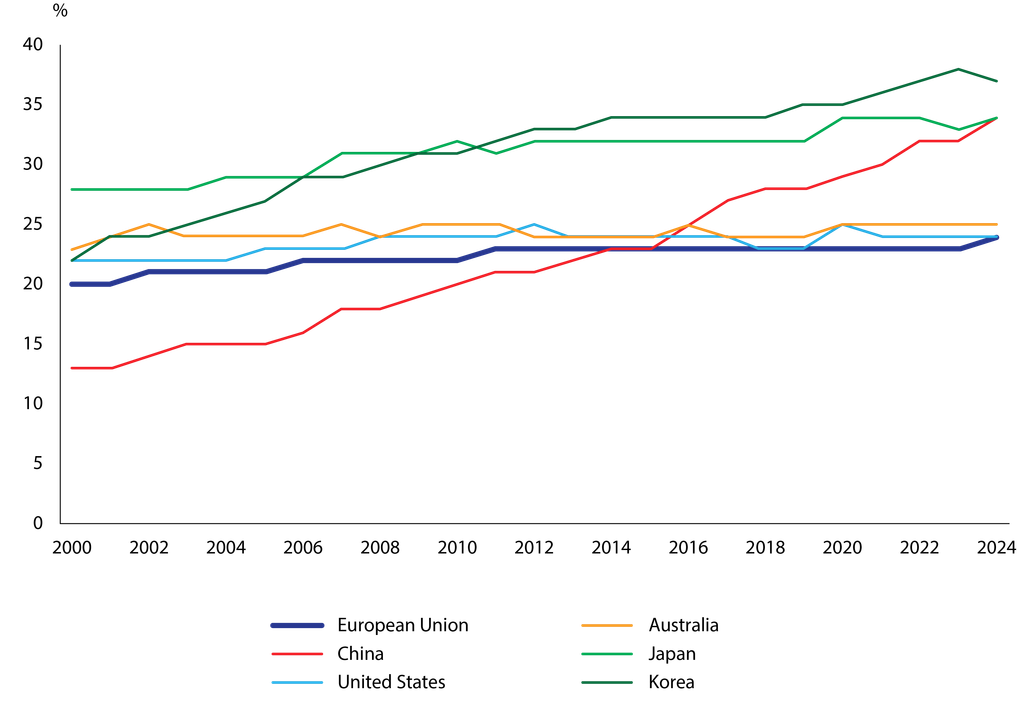
In the first quarter of 2026, EU day-ahead electricity markets recorded 1,223 hours of negative prices – more than twice the level of a year earlier, and ten times the number recorded in 2022. In Spain, prices fell below zero for 16% of all trading hours in the quarter (IEA 2026a). This should not be interpreted as evidence that Europe has an excess of clean electricity. With an electrification rate of only 24%, well below China’s 34%, Europe still requires substantial additional clean generation to reduce its dependence on fossil fuels (Figure 1).
Rather, this is evidence of insufficient electricity demand, flexibility, storage, and grid capacity to put the seeming surplus of clean power to good use.
Figure 1. Economy-wide electrification rate in selected regions, 2000-2024
Source: IEA (2006).
A decade ago, the energy transition’s central concern was that renewables were too expensive to compete with fossil fuels. That concern has been partly resolved: solar and wind are now the cheapest sources of new generation in most of the world. With battery costs down 93% relative to 2010 (IRENA 2026), intermittency – the drawback most commonly associated with renewables – may also become less of a constraint.
With the physical means to decarbonise electricity now largely available, what is increasingly in short supply is something different: the market arrangements needed to turn cheap technology into investment that is financed, built, and effectively used. This is the argument we develop in our recent survey paper (Fabra and Reguant 2026).
Why cheap renewables undermine their own investment case
The mechanism is well understood. As renewable capacity expands, its own output pushes down prices precisely when it is generating, since wind and solar compete with each other and against a near-zero marginal cost (Acemoglu et al 2017).
This ‘cannibalisation’ effect means that the price wind or solar plants actually capture falls further below the average market price as more renewables are added, even before any grid constraint binds – a pattern that persists even when generators bid strategically (Fabra and Llobet 2023).
Once oversupply is severe enough, prices turn negative and plants are curtailed due to excess supply. The threat of cannibalisation is even reshaping industry structure, as firms have an incentive to separate ownership of renewable and thermal assets in order to soften competition (Fabra and Llobet 2026b).
As prices captured by renewables risk falling below their average costs, the consequence is, as Paul Joskow (2019) put it, a ‘missing money’ problem: a revenue inadequacy to sustain existing capacity, let alone finance the next wave of investment. Left unaddressed, this can turn into a vicious circle.
Without sufficient revenues, investment in renewables slows; and without new investment, electricity remains expensive and volatile precisely when low, stable prices are what would encourage the electrification that could absorb the seeming surplus of clean power.
The lesson from Europe’s negative-price spring is not that there is already too much renewable energy. It is that a market and policy framework designed for scarce, dispatchable fossil generation is poorly suited to a system increasingly based on capital-intensive, low-cost and intermittent clean power
Long-term contracts are needed – so why the shortage?
There is broad consensus that long-term contracts are the fix: by delivering a stable price, they shield investors from cannibalisation and from wholesale-price volatility more broadly, lowering the cost of capital. Recent research confirms just how much is at stake.
Darmouni et al (2026) show that reliance on project finance backed by fixed-price contracts lets renewable developers substitute expensive equity with cheaper debt. May and Neuhoff (2021) estimate that the availability of fixed-price contracts can move financing costs for wind power by 30% of project value. In turn, by auctioning contracts, the lower cost of capital can be passed on to consumers through lower electricity prices.
If both buyers and sellers gain from long-term contracts, why are there not more of them? Part of the answer is that buyers are reluctant to lock in a fixed electricity price when wholesale prices might later fall below it. Likewise, when costs are exposed to inflationary pressures, locking in a fixed price can pose significant risks for projects with long lead times.
A second, more fundamental, part of the answer is counterparty risk. In recent work, Fabra and Llobet (2026a) show theoretically that the mere possibility that a buyer might try to renegotiate a contract when spot prices fall is enough, in equilibrium, to raise the contract prices sellers demand upfront – which in turn makes renegotiation more attractive, further limiting the scale of investment that can be profitably financed.
Ryan (2025) documents a closely related hold-up problem in India’s solar market, where weak enforcement of auction-awarded contracts depresses investment.
A public counterparty for those contracts can mitigate the risks that reduce contract liquidity in private markets. Yet, while public support in Europe has to be channelled through ‘contracts for difference’ (CfDs), member states are not resorting to them as much as would be needed to deploy investments at the pace and scale needed (Figure 2).
Assuring enough contract volume is a challenge, but not the only one: contract design must be right to induce an efficient use of the resources once in place. As Ambec et al (2025) argue, the ‘conditional’ CfD design adopted by the EU ties compensation to actual output rather than to a fixed reference price, distorting dispatch incentives in ways reminiscent of older feed-in tariffs.
Figure 2. Total awarded CfDs capacity for solar PV, onshore wind, and offshore wind in frontrunning countries, 2012-2023

Source: Demurtas et al (2026).
Contract design, in turn, is inseparable from auction design, since most long-term contracts for renewables are allocated competitively (Cantillon and Spagnolo 2026). A recurring finding is that price alone is a poor way to select winners, because otherwise identical projects can differ substantially in value depending on when and where they generate (Callaway et al 2018).
Ongoing work by Fabra and Llobet (2026c) shows that combining a fixed contract price with a degree of price exposure – rewarded through a scoring rule rather than price alone – can induce higher-value developers to bid more aggressively, improving the allocation of contracts without exposing investors to excessive risk.
Long-term contracts are necessary, but not sufficient
Even well-designed contracts cannot substitute for physical flexibility. The three margins that determine how much intermittency a power system can absorb are transmission, storage, and demand response – each an imperfect and only partial substitute for the others, while complementing renewable investments.
While transmission allows for physical flexibility through space, storage and demand response do so through time. For instance, batteries charge when solar floods the market during midday hours and discharge in the evening, reducing gas-fired generation, mitigating curtailment and increasing the profitability of solar investments.
Yet its deployment is not free of challenges: storage itself becomes less profitable as more of it is deployed, since arbitrage margins compress as hourly prices converge (Butters et al 2025, Andrés-Cerezo and Fabra 2023, 2026).
Sluggish electrification
The other side of this coin is electrification, which has lagged badly behind the growth in clean supply: EU electricity demand grew by just 1% in 2025, with industrial electrification being particularly slow (IEA, 2026b). This is not simply a matter of inertia. Borenstein and Bushnell (2022) show that retail electricity prices, loaded with network and policy charges recovered through volumetric fees, routinely exceed the social cost of electricity relative to fossil-fuel substitutes – discouraging exactly the demand growth that would absorb surplus renewable supply and support the prices that finance further investment.
Electricity price volatility contributes to further discouraging electrification. In this sense, electrification and renewable investment are two sides of the same coordination failure, and long-term contracting is one of the few instruments that can address both, by giving industrial and household consumers a predictable price against which to commit their investments.
The politics of the energy transition cannot be an afterthought
None of this can be designed in a vacuum from its distributional consequences. Jarvis (2025) estimates that local opposition and planning constraints have caused substantial underinvestment in UK wind and solar.
Purchase subsidies for electric vehicles, heat pumps, and rooftop solar have often accrued disproportionately to higher-income households able to afford the upfront cost (Borenstein and Davis 2025), while the costs and benefits of the broader transition – job creation and fiscal revenues in renewable-rich regions, or economic decline in fossil-fuel communities – are unevenly spread across places (Fabra et al 2024, Serra-Sala 2026, Fabra et al 2026).
Instruments that are efficient on paper but perceived as inequitable invite the political resistance that has already slowed transmission and renewable permitting across Europe and the US.
Market design is now the constraint
The lesson from Europe’s negative-price spring is not that there is already too much renewable energy. It is that a market and policy framework designed for scarce, dispatchable fossil generation is poorly suited to a system increasingly based on capital-intensive, low-cost and intermittent clean power.
Better long-term contracts and auctions, more investment in grids, storage and demand flexibility, and fewer barriers to electrification should therefore be treated as parts of the same challenge. Addressing that challenge is essential to pushing the energy transition forward.
References
Ambec, S, C Crampes and J Tirole (2025), “Contracts in the reform of the EU electricity market”, VoxEU.org, 7 March.
Acemoglu, D, A Kakhbod and A Ozdaglar (2017), “Competition in electricity markets with renewable energy sources”, The Energy Journal 38(1_suppl): 137–156.
Andrés-Cerezo, D and N Fabra (2023), “Storing power: Market structure matters”, The RAND Journal of Economics 54(1): 3–53.
Andrés-Cerezo, D and N Fabra (2026), “Storage and renewable energies: Friends or foes?”, The Economic Journal, forthcoming.
Borenstein, S and JB Bushnell (2022), “Do two electricity pricing wrongs make a right? Cost recovery, externalities, and efficiency”, American Economic Journal: Economic Policy 14(4): 80–110.
Borenstein, S and LW Davis (2025), “The distributional effects of U.S. tax credits for heat pumps, solar panels, and electric vehicles”, National Tax Journal 78(1): 263–288.
Butters, RA, J Dorsey and G Gowrisankaran (2025), “Soaking up the sun: Battery investment, renewable energy, and market equilibrium”, Econometrica 93(3): 891–927.
Callaway, DS, M Fowlie and G McCormick (2018), “Location, location, location: The variable value of renewable energy and demand-side efficiency resources”, Journal of the Association of Environmental and Resource Economists 5(1): 39–75.
Cantillon, E and G Spagnolo (2026), “Competitive tendering for renewables and industrial decarbonisation”, CEPR Discussion Paper 21628.
Darmouni, O, C Lehner and P Sastry (2026), “Financing investment in electricity”, SSRN Working Paper.
Demurtas, A, M Ansarin, C Bene, A Kralli, T Van Delzen, and L Van Nuffel (2026), “Overview of the diffusion of power-purchase agreements and contracts-for-difference across member states: Existing barriers and tools to favour their uptake”, Study for the Committee on Industry, Research and Energy PE 780.416, European Parliament.
Fabra, N, E Gutiérrez, A Lacuesta and R Ramos (2024), “Do renewable energy investments create local jobs?”, Journal of Public Economics 239: 105212.
Fabra, N, E Gutiérrez and R Ramos (2026), “The end of coal: Labor market transitions in coal-dependent regions,” EnergyEconLab Working Paper.
Fabra, N and G Llobet (2023), “Auctions with unknown capacities: Understanding competition among renewables”, The Economic Journal 133(651): 1106–1146.
Fabra, N and G Llobet (2026a), “The costs of buyer counterparty risk in long-term contracts”, CEPR Discussion Paper 21261.
Fabra, N and G Llobet (2026b), “Fossil fuels and renewable energy: Mix or match?”, RAND Journal of Economics 57(1): 140–157.
Fabra, N and G Llobet (2026c), “Scoring auctions with price exposure”, CEMFI, mimeo.
Fabra, N and M Reguant (2026), “Powering the energy transition: Progress and challenges”, CEPR Discussion Paper 21899.
IEA – International Energy Agency (2026a), “Fraction of negative hourly wholesale electricity prices in selected regions in the first six months of the year, Europe, 2019-2026”.
IEA (2026b), Electricity 2026: Analysis and forecast to 2030.
IRENA – International Renewable Energy Agency (2026), “Renewable power generation costs in 2026”.
Jarvis, S (2025), “The economic costs of NIMBYism: Evidence from renewable energy projects”, Journal of the Association of Environmental and Resource Economists 12(4): 983–1022.
Joskow, PL (2019), “Challenges for wholesale electricity markets with intermittent renewable generation at scale: the US experience”, Oxford Review of Economic Policy 35(2): 291–331.
May, N and K Neuhoff (2021), “Financing power: Impacts of energy policies in changing regulatory environments”, The Energy Journal 42(4).
Ryan, N (2025), “Holding up green energy: Counterparty risk in the Indian solar power market”, Econometrica, forthcoming.
Serra-Sala, C (2026), “Harnessing the wind: The impact of wind farm development on municipal finances”, Technical Report 11283, CESifo.
Editor’s note: This column is based on CEPR Discussion Paper 21899 ‘Powering the energy transition: Progress and challenges’, and was first published on VoxEU.org .