
AI takeover or slow grind?
Patrick Minford is Professor of Applied Economics at Cardiff University
There is regular comment in the press about the effects of AI on employment, productivity and growth, as well as concerns about general social effects. Opinions vary between fears of a growth explosion accompanying mass unemployment, with huge social tensions – a view that dominates the political debate – and at the opposite end reassurance that the progress of AI will be slow as it is gradually absorbed into the economy’s structure.
At the same time there is general agreement on the need to regulate AI output for social reasons in a variety of ways; this includes its use by young people on smart phones and its use by bad actors, such as terrorists. The latter agreement essentially just extends existing law to the use of AI; the question that has yet to be settled is quite how this is to be done, whether by setting up new regulation or by letting existing laws and law courts mandate action.
This issue of social regulation is important but not my focus here. Rather it is what concerns us economically: the other controversy over the economic effects of the AI revolution. Here we can be helped by the history of employment and output in the face of earlier systemic innovations, dubbed General Purpose Technologies, or GPTs.
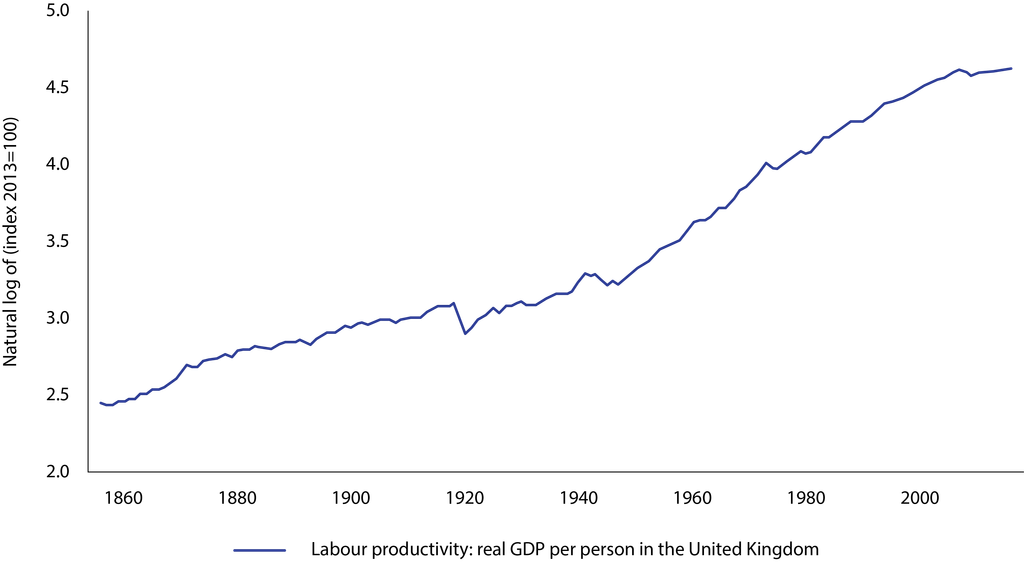
These include the invention of spinning and weaving machinery, the internal combustion engine, railways, electricity and the computer. These five GPTs arose between the 18th and the 21st centuries and it is instructive to see how trends in employment and output reacted to them in the UK economy, for which we have the longest data series on their impact. The charts that follow – all taken from the Bank of England’s historical databank – tell the story.
Figure 1. UK labour productivity from 1860
Source: Bank of England via FRED®
Figure 2. UK TFP growth since 1750
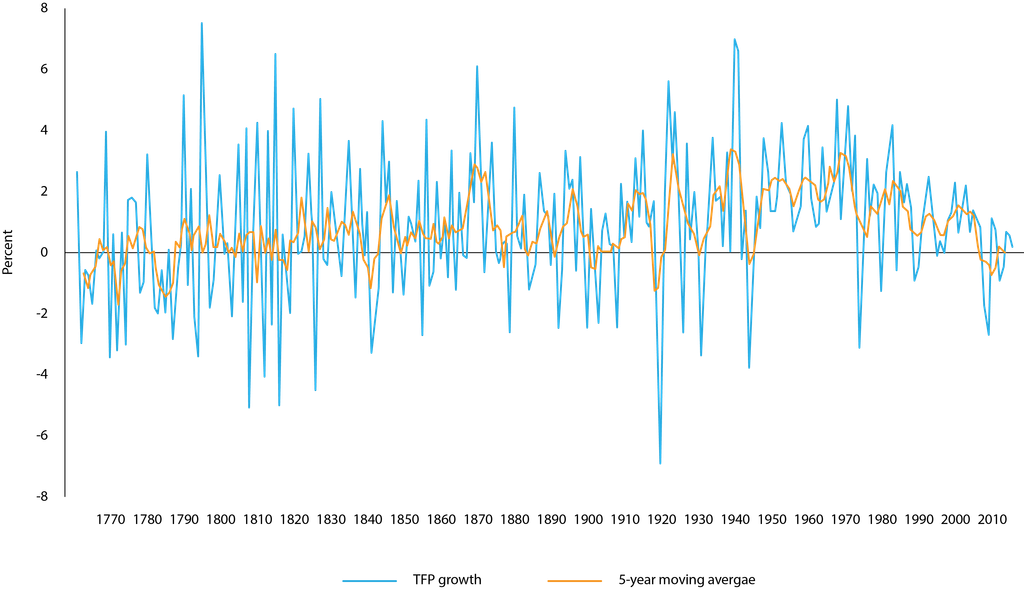
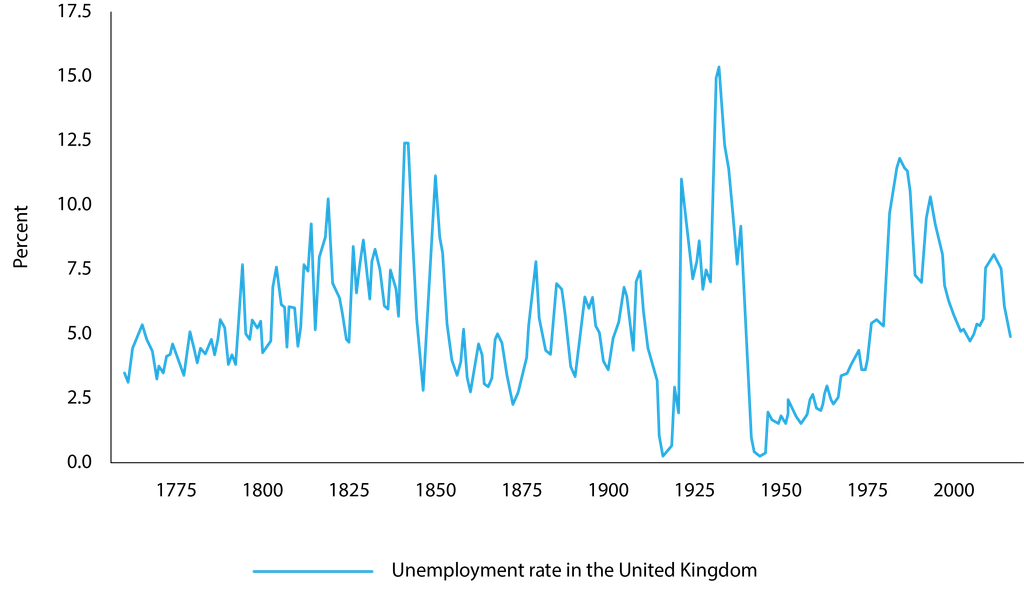
Figure 3. UK unemployment rate since 1750
Source: Bank of England via FRED®
Figure 4. UK Labour share of GDP from 1750
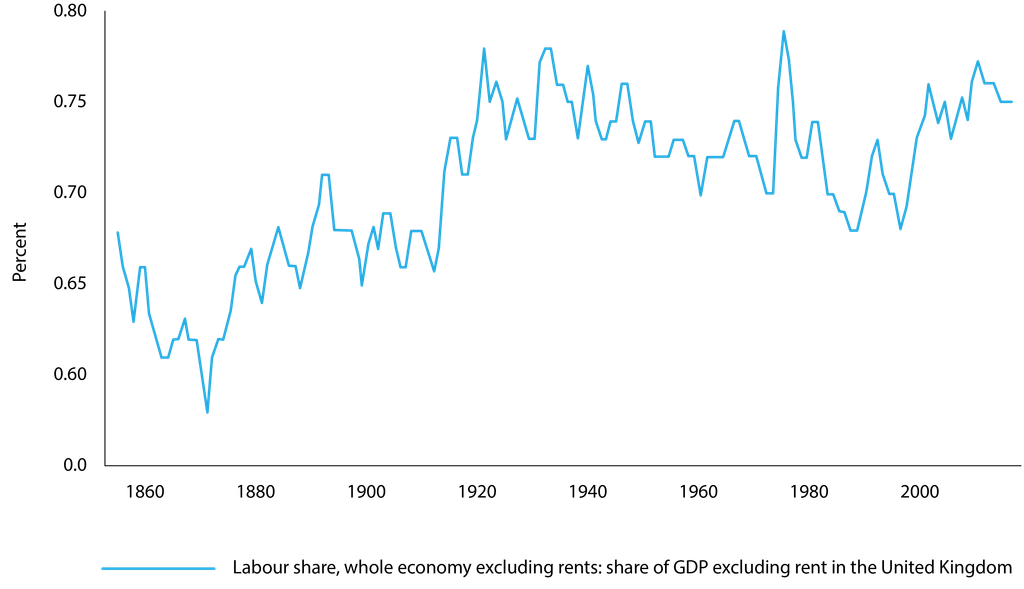
Source: Bank of England via FRED®
Figure 5. UK employment from 1750
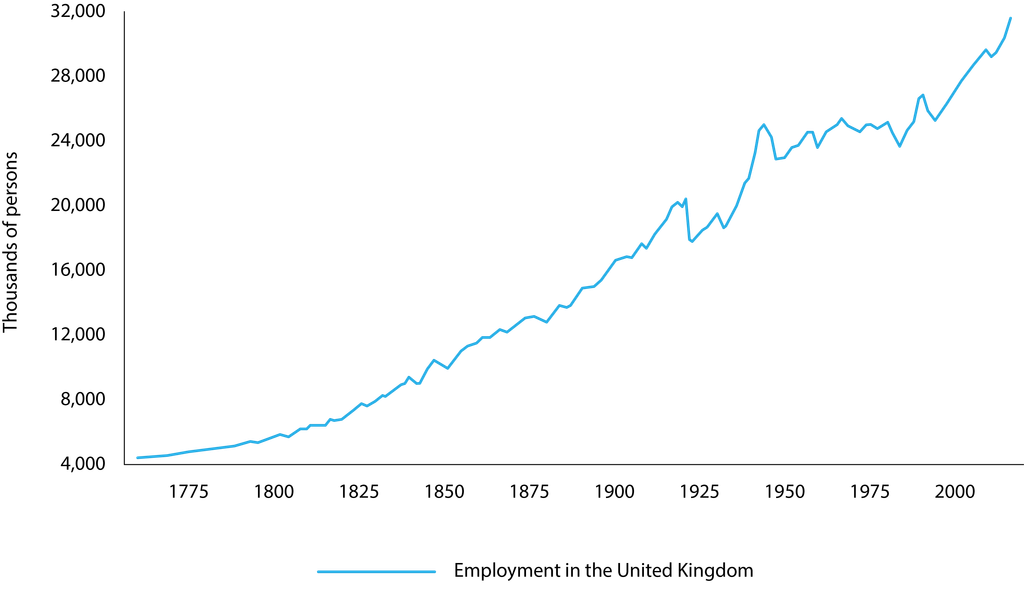
Source: Bank of England via FRED®
What we see from all these trends is that productivity and employment followed fairly steady upward trends throughout the three centuries of massive technological changes due to these GPTs. Most tellingly, the five-year-moving average of TFP (overall productivity) growth – see Figure 2 – fluctuated since 1750 at a rate between 0 and 3%.
There were many episodes of high unemployment but these are largely responses to financial and other macro shocks, ‘cyclical’ in other words, even if on occasions linked to ‘bubbles’ associated with GPT-related behaviour- such as the railways overbuilding in the middle of the nineteenth century (Figure 3 shows the sharp associated rise in 1850, which was soon over).
The biggest rise in unemployment was in the interwar period, and was related to monetary problems with the gold standard, and later the Great Depression – nothing to do with GPTs. Then the high unemployment of late 1970s was related to the oil crisis of 1975 and the battle against double digit inflation.
AI is unlikely to be different from other technology revolutions. It will take time for the world economy to assimilate the new methods into general business practice as new products and ways of working are found that use it effectively and safely
Hence the evidence suggests that previous GPTs did not cause employment dislocation but rather were absorbed into the economy in a rather steady way, gradually raising productivity and creating as many jobs as they displaced. This evidence therefore supports the ‘slow and steady absorption’ view of the AI revolution rather than the ‘big explosion’ view that is found in much of the political debate.
How can we account for this stability of these trends in the face of the massive technological shifts implied by these GPTs. It seems that the application of these GPTs required largescale changes in product types and methods of production to be fully profitable. Thus, for example it was not until Ford invented the Model T and scaled it to mass production that the full profitability of the internal combustion engine and electricity was achieved by business.
In the same vein Robert Solow famously joked in the New York Times in 1993 that the computer could be seen everywhere except in the productivity figures; yet now work across the whole economy relies on the computer, with massive cumulative productivity effects in total. This ‘Solow paradox’ has been seen to be resolved by the slowness with which new uses are found for a new GPT, as described above.
When we turn to AI, recent work (eg. Demirer et al (2026)) has found that AI is widely used by individuals in their work, and has become a huge cost to businesses as a result of the large use of ‘tokens’, but has not resulted in much increase in firms’ output.
Demirer et al suggest that AI will become profitable as new businesses built entirely on AI processing take over from currently dominant firms. Hence AI is following the usual path of GPTs with productivity growth being gradually raised as it is absorbed by industry into new products and methods.
This impression is strengthened by the recent commentary from business consultants. Thus, the latest Wharton report, which is more bullish than most, finds that only a third of businesses surveyed are making a ‘significant’ return on AI usage, this being led by smaller businesses. The latest McKinsey report (McKinsey Global surveys on the state of AI, 2017-2025) is sceptical of AI progress: over half of businesses surveyed are getting a revenue rise or cost reduction from AI, two thirds experimenting but not scaling up; no profit is reported yet.
The latest Cambridge Judge Business School survey of 600+ finance companies says only 40% report any profit and most only use AI for back-office tasks. Accenture says 90% of businesses are making no money so far. All this supports the ‘slow and steady’ view of the AI revolution.
One of the things that accompany early enthusiasm for a GPT is high investment by providers in the face of slow adoption. This creates conditions for a collapse in equity values of these early investors- usually dubbed the bursting of a ‘bubble’. This happened with the railways GPT overbuilding of the mid nineteenth century and also the dotcom boom of the 1990s.
The current massive wave of investment by AI providers in computers, cloud provision and data centres, may well be leading up to a similar crisis of overprovision. In 2025 global corporate AI investment was $582 billion, around 2% of US GDP where most of it is being commissioned, around half of it funded by venture capital as equity, the rest being borrowed.
This is still less proportionately than railways investment which reached 7% of UK GDP in 1847, but it may be enough to trigger a bust. In addition, the US Federal government spent $3.3 trillion on AI R&D in 2025, about 10% of GDP, whereas the government was not involved with railways investment. This difference, together with the wide popular backlash against the private investment in data centres because of their absorption of electricity and water resources, may be enough to avert a bubble and bust.
Looking at other details of how the AI revolution is being rolled out, it is clear enough that AI is easily used with strongly productive effect in certain areas such as repetitive search for new drug combinations, military target selection from wide selections fed in, and driverless cars.
These are areas where massive data troves can be fed in and these then can be used for tasks that search through these in a guided way. The problems encountered here are also daunting, mostly involving ‘hallucination’ where the AI picks a wrong combination as a solution. With drugs search this can be easily dealt with since the ‘discovered drugs’ can be checked by humans later.
However sometimes this is impossible. For example, in military targeting the whole point is to bypass the human element to achieve speed. Yet a wrong target such as the girls’ school selected in the bombing of Iran cannot be avoided once selected; the costs of such an AI hallucination are potentially huge – in terms of reputational damage, not to speak of the direct cost in lives. Much the same applies to driverless cars; one mistaken turn resulting in a terrible accident, could put back the prospects for driverless cars for a generation.
These are just examples of the ways in which using AI can fail to be valuable until there are future developments in product uses that avoid such problems or at least are no worse than the effects of endemic human error.
It is probably for this sort of reason that the latest job reports in the US and elsewhere have not suggested a collapse in jobs for new labour market entrants as once feared – see Figure 6 for total US employment that follows, which shows steady job creation apart from in the Covid episode.
The data for employment across the whole OECD tell a similar story – Figure 7. New entrants are needed to supervise the use of AI and avoid hallucinatory mistakes that can severely damage a firm’s reputation. These entrants in turn need to be trained for this task by existing employees that can pass on the necessary skills and cautionary philosophy.
To conclude, AI is unlikely to be different from other technology revolutions. It will take time for the world economy to assimilate the new methods into general business practice as new products and ways of working are found that use it effectively and safely. To do this people will be needed in employment to fashion the new world and train the new employees in the new methods. Even with AI the world economy will not turn on a dime.
Figure 6. Total US nonfarm employment
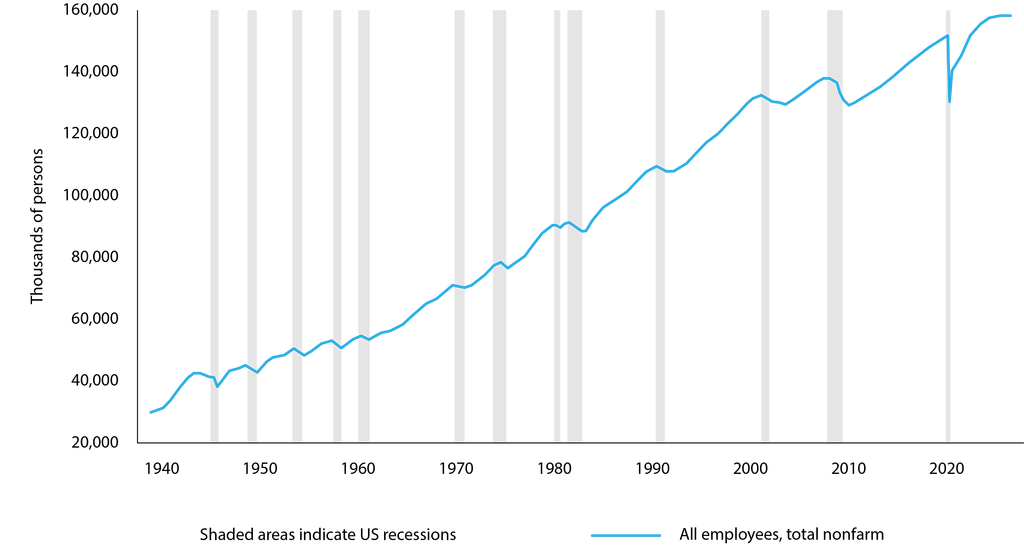
Source: US Bureau of Labor Statistics via FRED®
Figure 7. Total OECD employment rate
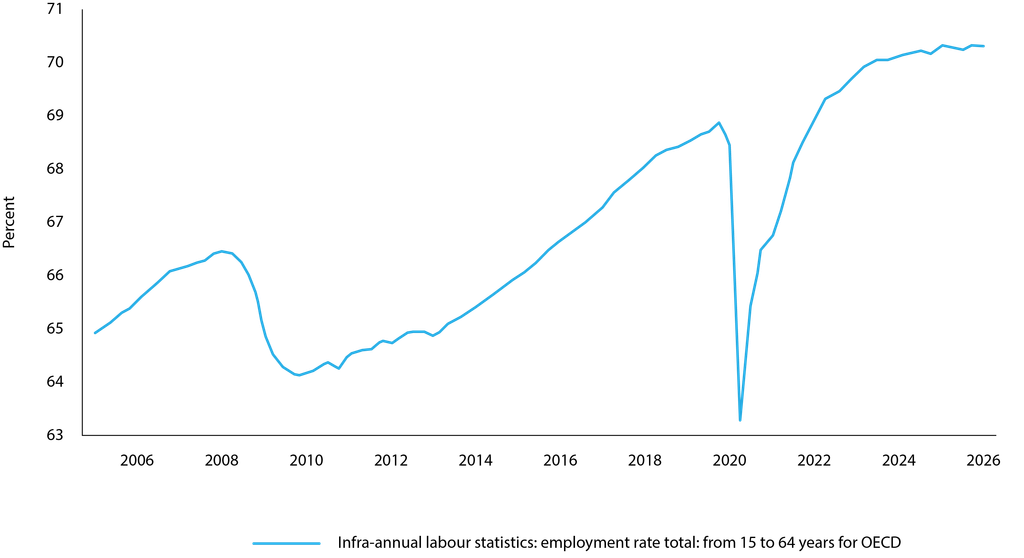
Source: Organization for Economic Co-operation and Development via FRED®