

How the rise of AI matters for fiscal policy
Karen Dynan Karen Dynan is Professor of the Practice in the Department of Economics at Harvard University, Douglas Elmendorf is a Professor of Public Policy at Harvard University’s Kennedy School of Government, and Louise Sheiner is the Robert S Kerr Senior Fellow in Economic Studies and policy director for the Hutchins Center on Fiscal and Monetary Policy at the Brookings Institution
The rise of artificial intelligence (AI) could have profound effects on the economy and society. Predictions of the economic effects have been offered recently by Acemoglu et al (2026), Amodei (2026), Imas (2026), Jones (2026), Karger et al (2026), and Trammell and Patel (2025), among many others. Specific predictions vary widely, but three potential effects of AI loom largest for most analysts and commentators: faster productivity growth, job losses, and shifts in the distribution of income.
In our recent paper (Dynan et al 2026), we examine four illustrative scenarios for the macroeconomic effects of AI and their implications for US fiscal policy. In the first scenario, AI is a rising tide that lifts all boats proportionally. In the second scenario, AI is again a rising tide, but income gains go only to people in the top quintile of the distribution. In the third scenario, we add significant job losses combined with offsetting increases in labour input elsewhere. And in the fourth scenario, AI causes even faster economic growth, major permanent job displacement, and income gains going exclusively to capital rather than labour.
For each scenario, we form a rough estimate of the effect on the US federal budget in the absence of policy changes, building on the latest projections from the Congressional Budget Office (CBO 2026b) covering the next three decades and on CBO’s (2025) analysis of the sensitivity of its projections to changes in economic conditions. We then consider what changes in tax and spending policies might be useful if that scenario were to unfold.
Our analysis points to five conclusions. Taken together, the conclusions show that the fiscal consequences of AI will depend not only on how much it raises national income, but also on who receives that income and how policymakers respond.
Effect of faster productivity growth
First, given current laws and the methodology used in budget projections, faster productivity growth stemming from AI would improve the budget outlook of the US government – but much of that improvement depends on projected spending patterns that are not consistent with policymakers’ past behaviour.
CBO projects that, under current law, US government debt held by the public will rise from 101% of GDP in 2026 to 175% of GDP in 2056. That projection incorporates an AI-induced increase in the annual growth rate of total factor productivity in the nonfarm business sector of 0.1 percentage points over the coming decade; the agency has not publicly quantified its assumptions about AI for later years.
We estimated that, if AI boosts annual productivity growth by a further 0.5 percentage points, the ratio of debt to GDP would be 39 percentage points lower than otherwise at the end of three decades, as shown by the thin solid line in Figure 1. Even so, debt would rise considerably relative to GDP.
Figure 1. Federal debt under different scenarios for the rise of AI
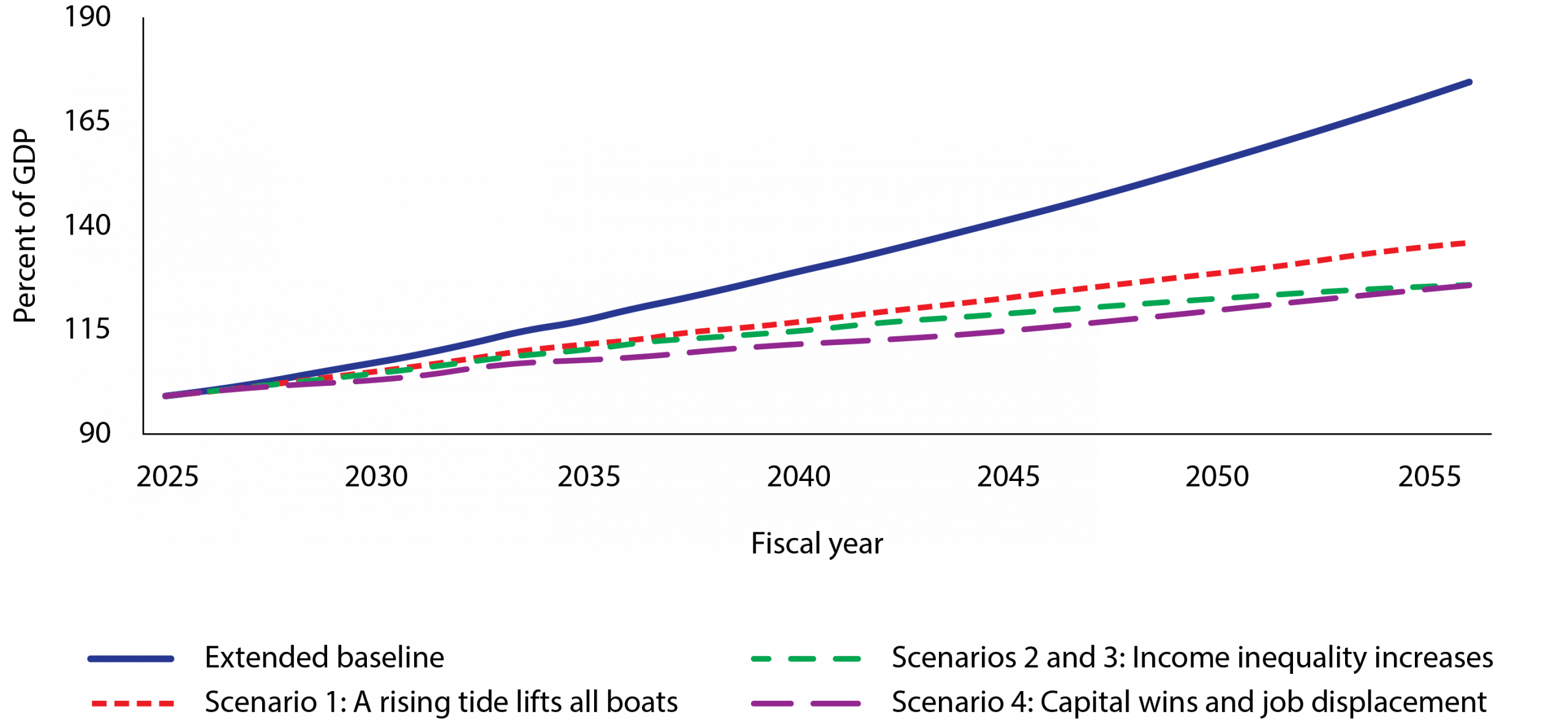
Note: Federal debt held by the public relative to GDP. Based on CBO’s (2026) extended baseline and authors’ analysis.
The difference in debt stems mostly from a reduction in noninterest spending relative to GDP, which occurs for two reasons. One reason is that payments in benefits programmes are projected to grow more slowly than GDP. In Social Security, this is because the law indexes the benefits of retired recipients to price rather than wage growth; in other benefit programmes, it largely reflects CBO’s methodology for projections, which we adopt in our analysis as well. We also assume, like CBO, that faster economic growth has no effect on discretionary spending (the spending that is set through annual appropriations) over the first ten years of the projections.
However, discretionary spending and spending for many benefits programmes have shown no trend relative to GDP over the past three decades or more. If policymakers responded to faster productivity growth by maintaining historical relationships between such spending and GDP, the budget outlook would not improve to the degree that is commonly expected.
Because the impacts of AI are potentially disruptive but deeply uncertain, policymakers should consider building insurance against the risks
Effect of higher income inequality
Second, a shift of income toward the top of the distribution because of AI would further improve the budget outlook if no policies were changed, but it could also spur demands for expanding the tax-and-transfer system to limit the rise in inequality.
An increase in inequality raises federal tax revenue because the tax system is progressive. CBO (2026a) reported that the average federal tax rate was about 21% for all households together and about 26% for households in the top quintile of the distribution. Accordingly, faster productivity growth with income gains confined to the top quintile of the distribution is projected to leave federal debt 49 percentage points of GDP lower than otherwise after three decades, as shown by the dashed line in Figure 1.
However, if that outcome occurred, it would likely strengthen arguments for greater income redistribution. Those arguments might point to the declining marginal utility of income, the importance of relative consumption for people’s wellbeing, and risks to democracy when some individuals acquire disproportionate political power. Increasing the progressivity of federal taxes and spending would have further effects on the budget outlook.
Effect of job losses
Third, job losses caused by AI might not have any automatic effect on the government budget beyond the effects of changes in productivity growth and the income distribution just described, but they would surely generate pressure on policymakers to adopt policies that reduce the harms of such losses.
Workers who lose jobs because AI supplants their line of work would generally struggle to find new jobs that match their skills, so some would be unemployed and others would leave the labour force. The foregone labour input might be made up through additional labour input of some other sort, perhaps from longer workweeks or AI-driven gains in human capital.
Under that assumption, GDP and the distribution of income would be the same as in the previous scenario, and federal debt would again follow the dashed line in Figure 1. Thus, displacement could impose large costs on affected workers without independently changing the government budget outlook.
An extensive research literature has shown that workers who lose jobs often suffer persistent earnings losses, develop significant health problems, and are hurt in other ways. For examples, see Jacobson, LaLonde, and Sullivan (1993), Couch and Placzek (2010), and Finkelstein et al (2026).
Policymakers could address these problems using at least three approaches: expanding unemployment insurance, establishing wage insurance, and expanding worker training and employment services. The latter two approaches have been part of the Trade Adjustment Assistance programme, and policymakers could modernise that programme and broaden eligibility to include workers who lose jobs for other reasons. Policy responses along these lines would offset some of the fiscal gains generated by faster growth.
Effect of a large shift of income to capital from labour
Fourth, if an AI-generated increase in national income went entirely to capital owners rather than being shared by capital owners and workers, the budget outlook would improve by less than if the gains were shared proportionally, and policymakers would likely face pressure to adopt policies that broadened the distribution of income gains.
The final scenario in our paper incorporated more dramatic potential effects of AI: an increase in annual productivity growth of 1.0 percentage points (compared with 0.5 percentage points in our other scenarios), major permanent job displacement, and income gains going only to capital. The foregone labour input would be made up, we assume, through additional capital investment, so there would be no effect on GDP or the budget from the loss of labour input itself. But the tax rate on capital income is significantly lower than the tax rate on income generally – by our rough estimate, more than 40% lower – which means that federal debt would be reduced by less.
In our calculations, the beneficial budgetary effects of higher income are just offset by the lower tax rate on that income, and debt would be reduced by 49% of GDP after three decades, as shown by the long-dashed line in Figure 1.
The major job displacement in this scenario would reinforce interest in unemployment insurance, wage insurance, and worker training and employment services that we just discussed. In addition, policymakers could explore ways to subsidise employment in the private sector or provide jobs in the public sector, and they could consider creating a Universal Basic Income programme. Once again, such policy responses would have further budgetary effects.
The shift in income shares from labour to capital would presumably also build pressure to increase the public return from the additional national income. Policymakers could increase the tax rate on capital income – through the existing structure of taxation, by taxing wealth (which might require a constitutional change), or by taxing consumption (presumably with an exclusion for moderate amounts of consumption).
Alternatively, policymakers could establish some public ownership of businesses, which might be similar in simple arithmetic to raising the capital tax rate but could differ in political robustness, sense of shared interests, and opportunities for avoiding payment. That approach could be implemented by creating a sovereign wealth fund or placing equity stakes in individual accounts, either of which would raise a host of complex and consequential policy choices.
Conclusion
Because the impacts of AI are potentially disruptive but deeply uncertain, policymakers should consider building insurance against the risks. For example, they could institute wage insurance and enhanced worker training on a limited scale to prepare for worker displacement or begin modest public purchases of equities to broaden participation in possible capital-income gains.
Starting modestly would position the government to scale up those efforts later if circumstances warranted. How fiscal policy responds to AI may become one of the central questions of economic policy in our time.
References
Acemoglu, D, D Autor and S Johnson (2026), “Building pro-worker AI”, The Hamilton Project, February.
Amodei, D (2026), The Adolescence of Technology: Confronting and Overcoming the Risks of Powerful AI. January.
Congressional Budget Office (2025), The Long-Term Budget Outlook Under Alternative Scenarios for the Economy and the Budget. Congressional Budget Office.
Congressional Budget Office (2026a), Supplement to “The Distribution of Household Income, 2022”: Supplemental Data. Congressional Budget Office.
Congressional Budget Office (2026b), The Long-Term Budget Outlook Data: 2026 to 2056. Congressional Budget Office.
Couch, KA and DW Placzek (2010), “Earnings losses of displaced workers revisited”, American Economic Review 100(1): 572–589.
Dynan, K, D Elmendorf and L Sheiner (2026), “How might fiscal policy respond to the rise of artificial intelligence?”, NBER Working Paper 35437.
Finkelstein, A, MJ Notowidigdo and SX Shi (2026), “Trading goods for lives: NAFTA’s mortality impacts and implications”, NBER Working Paper 34855.
Imas, A (2026), “What will be scarce?”, Ghosts of Electricity (Substack blog), 14 April.
Jacobson, LS, RJ LaLonde and DG Sullivan (1993), “Earnings losses of displaced workers”, American Economic Review 83(4): 685–709.
Jones, CI (2026), “A.I. and our economic future”, NBER Working Paper 34779.
Karger, E, et al (2026), “Forecasting the economic effects of AI”, NBER Working Paper 35046.
Trammell, P and D Patel (2025), “Capital in the 22nd century”, Substack blog, 29 December.
This article was originally published on VoxEU.org.