
Europe’s strained social model
Marco Buti is a Part-time Professor at the European University Institute, and André Sapir is a Senior Fellow at Bruegel
The Trente Glorieuses and now
Through the rest of 2026 and in 2027, two-thirds of the European Union population will go to the polls in a series of national and regional elections1. A common feature in many EU countries is the rise of populist and nationalist forces. Why? We argue that the roots of this phenomenon lie in a systemic crisis of the European social model which, for over half a century, has defined Europe’s socioeconomic identity.
While varying across countries (Sapir 2006, 2025), European social models all embed social cohesion into the architecture of economic governance by balancing market dynamics with universal healthcare, state pensions, education, labour-market regulations and collective bargaining. The European social model has thus enabled the coexistence of capitalism and democratic stability based on a broad intellectual consensus – including among leading political parties – robust organised labour, a dense network of intermediary institutions and favourable demographic conditions.
But these pillars underpinning post-war European stability have eroded. European societies are increasingly fractured economically and socially (poor versus rich, urban versus rural)2, culturally (traditional versus ‘modern’ values) and generationally (young versus old). The historical conditions that gave rise to Europe’s welfare regimes during the Trente Glorieuses (1945-1975) no longer exist.
Post-war reconstruction rested on an explicit Beveridge-Keynes consensus, supported by dominant democratic coalitions that regularly commanded two-thirds of the electorate. Today, political fragmentation has shattered these alignments, pushing their combined vote well below 50 percent in many EU countries. To prevent these fractures from becoming a permanent rupture, Europe must forge a renewed social contract.
Structural roots of the crisis of the European social model
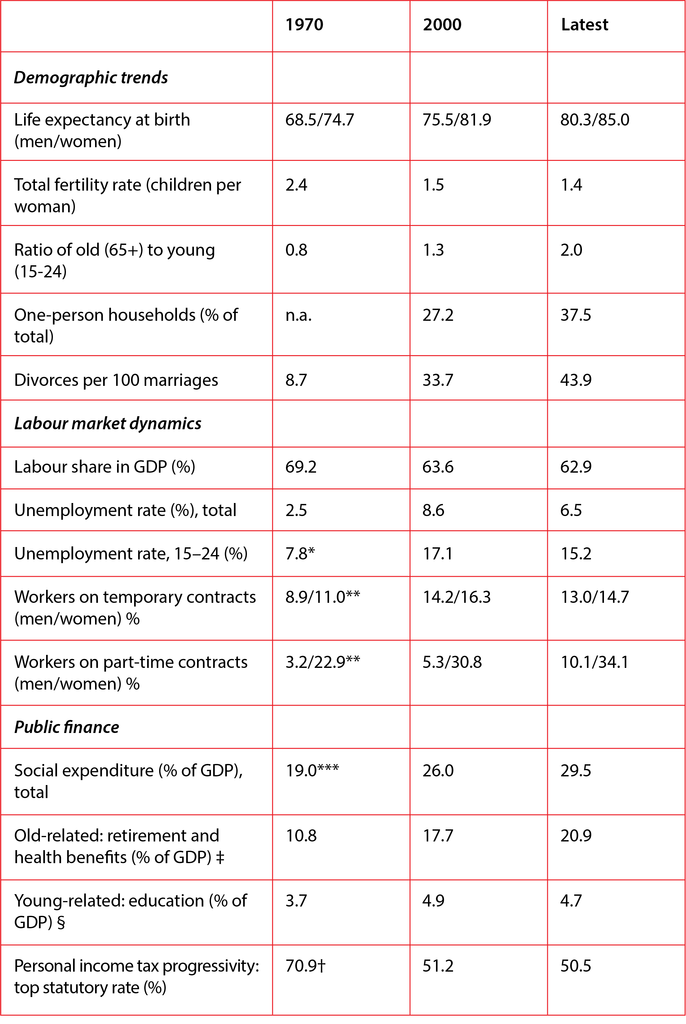
Three main underlying pressures are particularly visible (Table 1):
1. Demographic squeeze: Europe’s total fertility rate has fallen below 1.4, well short of the replacement level of 2.1, while life expectancy at age 65 continues to rise. As a result, the political weight of the old generation has increased significantly compared to the young generation. The ratio of old (65+) to young (15-24) has increased from less than one in 1970 to two currently. The share of public expenditures mainly related to the old (pension and health benefits) has more than doubled, reaching more than 20 percent of GDP, while the share mainly allocated to the young (for education) has increased by far less, now accounting for a little below five percent of GDP. These trends have fuelled intergenerational grievances.
2. Household atomisation: one-person households now represent over 35 percent of all European households, while changing family structures (with more than 40 percent of new marriages now ending in divorce) have weakened traditional care networks. As the support burden shifts to underfunded state social services, vulnerable citizens feel abandoned by mainstream institutions.
3. Labour-market insecurity: while headline unemployment has stabilised, non-standard employment has expanded. Over a quarter of women work part-time, and temporary contracts affect over 11 percent of the workforce. Trade union membership has weakened, with many workers caught in working arrangements without union representation. This has resulted in a significant decline in the share of labour in GDP. The rise of artificial intelligence may intensify these pressures by accelerating changes in work organisation and the demand for new skills. Pressure is particularly high on those under 25, for whom the unemployment rate in the EU stands at over 15 percent, compared to six percent overall.
Table 1. A fragmented EU social landscape (pre-2004 EU members excluding the UK)
Notes: EU14 (EU15 excluding the UK): weighted averages of country data; top income tax rate: simple average. Latest year: 2023 for divorces; 2024 for life expectancy, fertility and expenditure items; 2025 otherwise. *1975, OECD (only nine EU14 countries). **1987 (only 11 EU14 countries, excluding Austria, Finland and Sweden). *** Buti et al (1998). † Own computation using OECD and CITD (Genovese et al 2016); 11 EU14 countries. ‡ Retirement: IMF (2011), including disability pensions, for 1970 and 2000; Eurostat for the latest year. Health: OECD; only 10 EU14 countries in 1970. § World Bank for 1970 (only 10 EU14 countries) and 2000 (13 EU14 countries); Eurostat for the latest year.
Source: Bruegel based on Eurostat, AMECO (European Commission), OECD, IMF, World Bank and CITD data.
Politics needs to reinvent Europe’s social model
The European social model remains one of Europe’s greatest achievements, but its survival cannot be taken for granted. Traditional political parties often frame social policy choices around belt-tightening. Nationalist parties have seized on this fiscal anxiety by promising to preserve traditional social benefits while restricting them to native citizens under a banner of national preference. Where mainstream politics offers fiscal retrenchment, populism offers defensive protectionism. Both are misguided and hence bound to fail.
To construct a new political consensus, mainstream political forces must offer an ambitious vision of a European social market economy that combines economic dynamism with tangible social protection. The political credibility of these mainstream forces will depend on their ability to translate this vision into policies that address citizens’ insecurities, rather than simply denouncing populist rhetoric.
Proposing a blueprint for reform goes well beyond the scope of this analysis. Our goal is simply to outline issues that need to be tackled to rebuild a social compact able to deliver economic dynamism and social protection in the new environment described in the previous section.
Three main issues require urgent political debate and, ultimately, solutions.
1. The primary responsibility for reforming Europe’s social model(s) rests with EU national governments. With national public social expenditure taking up nearly 30 percent of EU aggregate GDP, the choice, delivery and financing of social programmes are grounded in national politics. But it is not only a question of scale: the internal coherence of national welfare systems is vital. The experience of the Nordic and some other EU countries shows how high levels of social protection can go hand-in-hand with economic dynamism, actively encouraging entrepreneurship and technology adoption by reducing the personal cost of transition failures. However, in these countries national social protection policy is embedded in a coherent ‘social compact’ with well-functioning labour and product markets, including deeper and more integrated capital markets. Ensuring coherence across policies that are mainly national is the reason why reforming social models will remain the primary responsibility of national governments.
2. A credible proposal requires a recasting of the European social model itself. The welfare state should not be seen only as a mechanism for redistribution; rather it should be an engine of human-capital formation and economic dynamism (Hemerijck 2017). Social policy is not simply a cost to be managed, but a prerequisite for economic efficiency and resilience. Formal education, lifelong learning, skills retraining and other active labour-market policies do more than protect workers. They equip people to adapt to technological change, support innovation and facilitate economic transitions, hence fostering economic growth and helping to finance the welfare system.
3. Difficult political trade-offs must be addressed. By framing social investment as a driver of economic opportunity rather than a burden on public budgets, democratic political forces can rebuild an inclusive narrative that directly addresses the roots of popular disaffection. But simply changing the framing is not enough.
The sharing of public expenditures between the old and young also needs to change. Retirement benefits and healthcare expenditures (typically accounting for roughly 20 percent of GDP in EU countries) need to be rebalanced with education (typically around five percent of GDP; Table 1).
To construct a new political consensus, mainstream political forces must offer an ambitious vision of a European social market economy that combines economic dynamism with tangible social protection
How can Europe help?
While national governments must rebuild their welfare systems, the EU can play a vital role. The EU has a collective interest in well-functioning social models in its member countries for geopolitical reasons. The attractiveness of Europe to third countries and regions that do not want to be squeezed between the United States and China rests on building hard power but also, and equally importantly, on showing that a viable balance between efficiency and equity exists and is sustainable economically, politically and socially.
Currently, EU citizens often view the EU primarily as an enforcer of fiscal constraints, state-aid limitations, trade agreements and market competition, while looking exclusively to national institutions for healthcare, education and social protection. Nationalist movements exploit this asymmetry, portraying the EU as a distant elite project that wants to erode national sovereignty and social protection. Reforming social models could help redress this misperception in three ways. The EU can:
1. Act as a facilitator for reforms of national social programmes;
2. Complement the single market and competitiveness strategy with a social pillar;
3. Foster social convergence.
In pursuing these goals, the EU should use its three main instruments – budget, regulation and coordination – in synergy (Buti et al, 2026).
The EU as facilitator boils down to providing incentives to help member countries overcome domestic resistance to change. For this task, two instruments are well suited: the EU budget and coordination through the European Semester economic surveillance and coordination exercise3.
In terms of using EU social programmes to complement market liberalisation, it is useful to recall the experience of the Delors Commission in the late 1980s. To avoid a social backlash, the creation of the single market was coupled with the setup of cohesion policies via the Delors Packages4, alongside the promotion of social dialogue. This approach combined efficiency and equity, market discipline and cohesion policy.
A similar approach must be pursued today: the EU must broaden its competitiveness strategy focusing on growth (Draghi 2024; Letta 2024) to include a social cohesion strategy, just as in the 1980s it added a social dimension to its single market strategy. Growth and social cohesion are complementary: growth helps finance social-cohesion programmes, and well-designed social cohesion fosters growth.
Finally, the EU should care about social convergence, which is a core part of cohesion. Protecting high social standards and preventing regulatory races to the bottom should become common priorities. With technological developments, especially AI, a sizeable education programme financed by the EU budget would send a clear and forward-looking message5.
Ultimately, the challenge is to demonstrate the EU’s added value rather than resorting to political posturing, or overpromising and failing to deliver. The ongoing battle over the EU’s 2028–2034 budget illustrates just how difficult it will be to reconcile ambitious common priorities with short-term national budgetary objectives (Darvas 2026)6.
Overcoming the ‘fragmentation trap’ is essential if Europe is to resist the appeal of demagogues of different political colours and preserve the social and democratic foundations on which its integration project rests. Europeans do not want a low-welfare, high-inequality social system. The good news is that there is no need for this.
Endnotes
1. Including national parliamentary elections in Finland, Greece, Italy, Poland and Spain, and France’s April 2027 presidential election.
2. Already in 1995, then French presidential candidate Jacques Chirac famously denounced “la fracture sociale” but did little to address it in office. See Kévin Boucaud-Victoire, ‘“Fracture sociale” : mais d’où vient cette expression si Chirac ne l’a pas inventée ?’ Marianne, 24 July 2022.
3. See Council of the EU explainer, ‘The European Semester explained’.
4. The Delors Packages reformed the then European Community budget. Package I (1988-92) set up the first multiannual plan (five-year) for the EU budget and significantly increased the size of funds deployed to poorer regions to accompany the single market and the southern enlargement (Greece, Portugal, Spain). Package II (1993-99) extended budgetary planning to a seven-year framework and provided additional funding to social and cohesion policy, partly related to the creation of the euro. See CVCE, ‘Reform of the Community budget: The Delors Packages’, undated.
5. Such a programme could build on the Erasmus+ programme; see European Commission, ‘Erasmus+: EU programme for education, training, youth and sport’.
6. See also Rosalba Famà, ‘The social pillar in the next Multiannual Financial Framework’, Commentary, 31 October 2026, IEP@BU.
References
Buti, M, G Corsetti and A Peychev (eds) (2026) Reconfiguring Europe in a Fractured Global Economy, The 2026 EMU Lab Florence Report, European University Institute.
Buti, M, D Franco and L Pench (eds) (1998) The Welfare State in Europe: Challenges and Reforms, Edward Elgar.
Darvas, Z (2026) ‘More flexible European Union spending needs stronger parliamentary scrutiny’, Analysis 32/2026, Bruegel.
Draghi, M (2024) The future of European competitiveness. Part A: A competitiveness strategy for Europe, Publications Office of the European Union.
Genovese, F, K Scheve and D Stasavage (2016) ‘Comparative Income Taxation Database’, Stanford University.
Hemerijck, A (ed) (2017) The Uses of Social Investment, Oxford University Press.
IMF (2011) ‘The Challenge of Public Pension Reform in Advanced and Emerging Economies’, mimeo, International Monetary Fund.
Letta, E (2024) Much More Than a Market.
Sapir, A (2006) ‘Globalization and the Reform of European Social Models’, Journal of Common Market Studies 44(2): 369–390.
Sapir, A (2025) ‘Globalisation and the reform of European social models’, Policy Brief 22/2025, Bruegel (original work published in 2005).
The authors thank Pedro Lomo for research assistance and, without implicating them, Anton Hemerijck, Mario Nava and Bruegel fellows for helpful comments on an earlier draft. This article is based on a Bruegel Analysis.