

A strategic lever to boost global decarbonisation
Georg Zachmann is a Senior Fellow and Annabelle Weisser is an Energy and Climate Programme Officer, both at Bruegel
Executive summary
Article 6 of the Paris Agreement provides a framework for international carbon trading under which countries can agree to buy and sell emissions reductions to meet their national climate targets, or for other international mitigation purposes, such as in aviation. In this context, the European Union will allow up to five percentage points of its 2040 climate target to be met through purchases of international credits.
This opportunity should be used not merely as a cost-saving mechanism but should be a tool to encourage and increase global emissions reductions. We propose a combination of two institutional innovations: a Carbon Buyers’ Club that would ensure common quality standards, and a set leverage ratio to ensure that every unit of domestic emissions offset leads to a greater amount of mitigation abroad.
Within a market-based architecture, private buyers should be able to use international credits as collateral to borrow domestic allowances. Through this controlled exchange against EU allowances, the system would link international flexibility to domestic compliance systems, in this case the EU emissions trading system.
To safeguard environmental integrity our proposal would move away from project-based crediting. Instead, partner countries would allocate portions of their own emissions reductions to other countries, and would receive in return direct financing, project-based investments or both.
1 Introduction
Compared to much of the rest of the world, Europe has had some success in cutting emissions. The European Union’s share of global greenhouse-gas emissions dropped from 15 percent in 1990 to 6 percent in 20241. However, even if the EU were to reach net zero tomorrow, the total impact on global warming would be limited.
To meaningfully contribute to global emissions reduction efforts, in a context in which the world is far from keeping global warming well below two degrees Celsius above pre-industrial levels (UNEP 2025), the EU must leverage its impact not only domestically but also abroad.
The EU’s first tool to push for more climate change mitigation internationally is diplomacy. EU diplomacy was a major driver of the United Nations Framework Convention on Climate Change (UNFCCC) process that culminated in the 2015 Paris Agreement, which provides a universally accepted legal basis for policy instruments that the EU and others can use to catalyse emission reductions beyond their borders. The UNFCCC process is thus also a major driver of EU climate policy (Pisani-Ferry et al 2023).
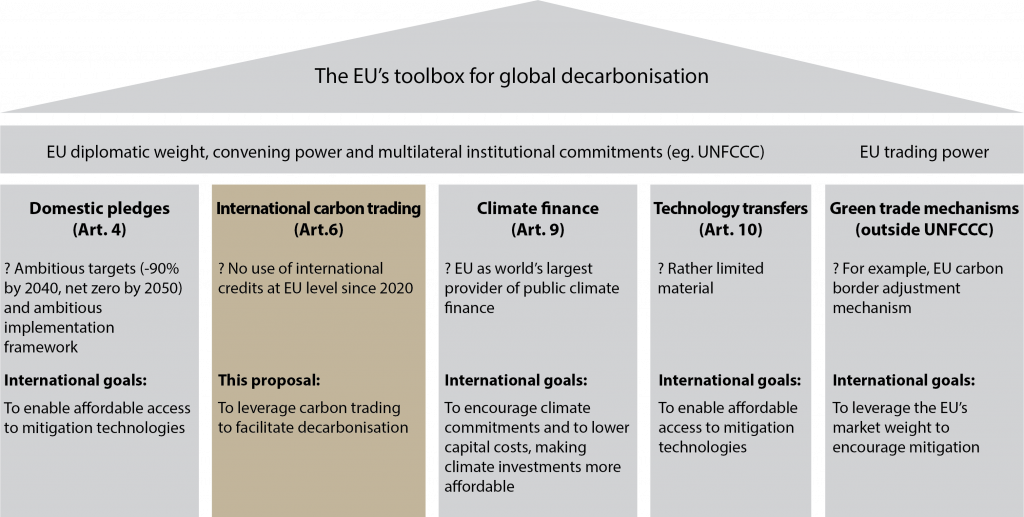
Beyond its diplomatic weight, the EU has used five main levers to encourage climate change mitigation abroad (Figure 1):
1. By pledging ambitious domestic emission reductions (Paris Agreement, Art. 4), the EU sets an example for others to also make significant mitigation commitments. To meet its ambitious targets, the EU has developed policies, technologies and expertise, which in principle lower costs and reduce uncertainties for countries that follow suit2.
2. The EU is the world’s largest provider of climate finance (Art. 9)3. This support encourages developing countries to make climate commitments and reduces their capital costs for mitigation investments.
3. By facilitating technology transfer (Art. 10), the EU could in principle enable developing countries to gain more affordable access to mitigation technologies.
4. By implementing green trade mechanisms (such as the carbon border adjustment mechanism, CBAM), the EU can encourage trade partners to introduce mitigation policies and decarbonise their industries.
5. International carbon markets (Art. 6) can encourage substantial emission reductions in countries with low mitigation costs.
Figure 1. International carbon trading as a pillar of EU international climate policy
Source: Bruegel.
However, some levers have more potential than others. There is limited scope for the EU to further tighten domestic climate targets or to provide dozens of billions of euros in additional international climate finance. The EU’s diplomatic weight and technology leadership have not increased since the Paris Agreement was negotiated. But green trade policies are a promising development (Bahí et al 2026), and international carbon trading is making a return.
A framework for international carbon trading is provided by Article 6 of the Paris Agreement. This allows countries to cooperate bilaterally by transferring emission reductions, known as Internationally Transferred Mitigation Outcomes (Article 6.2). Buyers can use these transfers to meet their national climate targets or for other international mitigation purposes, such as in aviation. To maintain environmental integrity, these transfers must be carefully accounted for and tracked throughout their lifecycle using reliable national or international registries.
Article 6 also established a centralised, UN-supervised international carbon crediting mechanism (Article 6.4). Under this framework, approved mitigation activities generate unique emission reduction credits that are recorded and traced within a central registry.
Finally, it provides a framework for non-market cooperation by countries to reduce emissions (Article 6.8), which does not involve the generation or transfer of tradable carbon credits.
If well designed, international carbon trading can become a strategic instrument in the EU’s toolbox to encourage international climate change mitigation. At the climate summit (COP29) in Baku in 2024, UNFCCC participants finalised the Article 6 rulebook, allowing countries to procure and use international carbon credits4 to achieve climate targets.
In 2025, the EU decided to allow up to five percentage points of its 2040 climate target – under which emissions should be cut by 90 percent compared to 1990 – to be met by high-quality international credits (Regulation (EU) 2026/667).
Such trade in mitigation outcomes can lower the global cost of decarbonisation, as substantial volumes of abatement, especially in emerging market and developing economies (EMDEs), are still relatively cheap5.
However, there are considerable risks involved in international carbon trading. Previous experiences exposed profound weaknesses. Under the Kyoto Protocol’s Clean Development Mechanism (CDM), many credits were issued for claimed emission reductions that were likely overestimated and may have happened regardless of whether or not credits were issued (Cames et al 2016). These concerns were the motivation behind the San José Principles, which advocated stricter integrity rules6.
However, the safeguards ultimately adopted in the Article 6 rulebook fell short of these standards7. This failure to implement higher-integrity rules undermines trust in international carbon markets and fuels justified scepticism towards offsetting (Asadnabizadeh and Moe 2024).
If credits on paper count towards buyer countries’ climate commitments without corresponding to real emission reductions in seller countries, they risk undermining the fundamental architecture of the Paris Agreement. And without sufficient safeguards, Article 6 risks creating a race to the bottom: buyer countries are incentivised to minimise compliance costs, while seller countries seek to maximise credit selling. The fundamental challenge is to create incentives for all participants to adhere to environmental integrity standards.
These integrity concerns are particularly pronounced when credits are sold by individual project developers. Since project-based credits rely on hypothetical estimates of what emissions would have been without the project, it is often difficult to verify whether claimed emission reductions are real, additional and permanent (Fuchs et al 2026). While safeguards in the Article 6 rulebook are intended to improve the integrity of credits, they cannot eliminate the fundamental uncertainty around project-based credits.
Despite the challenges, the EU has limited time to set up a functioning carbon market. Its five-percentage point allowance for emissions cuts to be met through ‘high-quality international credits’ (Regulation (EU) 2026/667) applies from 2036 (Montrone et al 2026). A pilot period from 2031 to 2035 will establish a market for these credits.
Strategic decisions on how international carbon credits will be used in the EU need to be taken now and are expected in 2026/2027. In the framework of a review of the EU emissions trading system (ETS)8, the European Commission proposed on 17 July 2026 to set up a separate compliance mechanism for international credits (European Commission 2026).
However, the Commission proposal is only the beginning of the conversation, and the Commission is expected to present a “framework for the possible use of international credits towards the 2040 EU climate target under the European Climate Law” in late 20269. Together with other legal acts, the EU needs to develop a consistent climate policy framework after 2030 that includes the strategic role of international credits10.
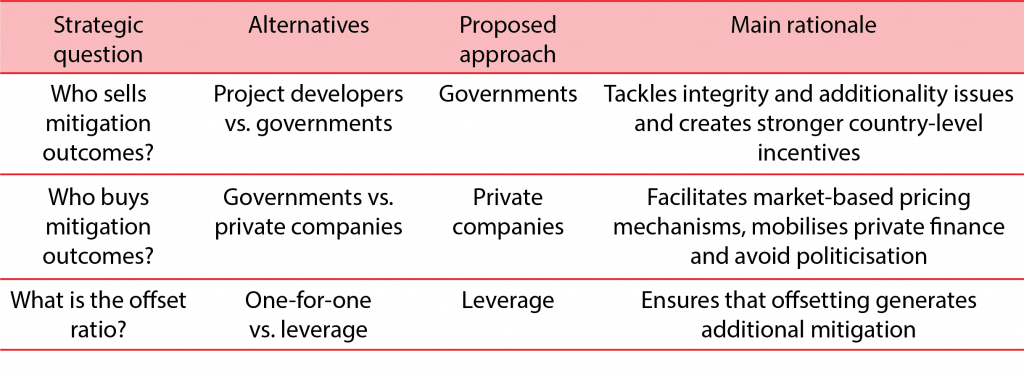
This Policy Brief outlines a proposal for how to make Article 6 work to catalyse global emission reductions. The proposal rests on three principles: i) country-issued credits instead of project-based ones, ii) private buyers instead of public buyers, iii) and a leverage ratio that implies that the EU should use international carbon trading to encourage mitigation abroad, rather than just transferring carbon emissions from one region to another.
Section 2 spells out these principles as fundamental choices, including arguments for why certain avenues should be prioritised over others. Section 3 outlines how this could work in practice. Section 4 discusses conceptual uncertainties.
To keep climate protection alive, the EU should focus its climate policy on its global impact and design its international credits procurement strategy accordingly
2 Fundamental choices
Strategic questions about how the EU uses Article 6 include who procures foreign credits (the EU, national governments or companies), in which compliance mechanisms they will be accounted for and how to determine the minimum acceptable quality of foreign credits (Delbeke and Bencini 2026).
2.1 Who sells credits? Project developers vs. governments
We recommend moving away from project-based mitigation trading to issuance of carbon credits at national level. The certification of individual mitigation projects poses several environmental-integrity risks related to the measurement, questionable permanence and additionality of credits (Fuchs et al 2026; Edenhofer et al 2026).
These challenges make it nearly impossible to assess consistently how much additional mitigation projects deliver over time. In contrast, countries could make parts of their own emissions reductions available to count towards other countries’ climate commitments – the Nationally Determined Contributions (NDCs) (Delbeke and Bencini 2026). Seller countries would retain full discretion over whether they receive direct financing, project-based investments or a combination of both in return.
This builds on existing concepts: the international transfer of carbon credits under Article 6 triggers a ‘corresponding adjustment’ in the host country’s NDC; ie. by buying foreign credits, buyers already obtain a share of the seller country’s carbon budget.
At the same time, host countries can require ‘benefit sharing’ from project developers in the form of a share of credits or a tax. In our proposal, seller countries, rather than project developers, are the issuers of carbon credits. This implies that the value of a credit depends not on the mitigation achieved by a specific project, but on a country’s mitigation success compared to a baseline emission pathway.
2.2 Who buys credits? Governments vs. private companies
As an alternative to public entities buying foreign credits, private companies should buy foreign mitigation outcomes to exchange at home for domestic allowances. If public entities such as the European Commission or national governments buy foreign credits, there is a risk of politicising the trade.
To domestic audiences, the purchase of foreign credits with public money could look like substantial hand-outs to companies and foreign governments. Internationally, countries unable to sell because of a lack of mitigation capacity might perceive this as a political rather than environmental or economic choice.
However, if private companies can buy foreign credits to obtain domestic compliance relief, they will try to get the highest volume of domestic compliance at the lowest price. If the domestic compliance value of a specific seller country’s credit can be made to align with the effective emission mitigation of that country within a certain timeframe (eg. 2030-2040), private companies will have an incentive to deploy market-based information systems to determine the value of each seller country’s credits.
In the EU, private companies would have an incentive to buy foreign mitigation outcomes if they can be used for compliance in the ETS or the separate ETS2, which covers emissions related to buildings and road transport11.
2.3 Offset ratio: one-for-one vs. leverage
Finally, the purchase of foreign credits should be designed to accelerate global decarbonisation. The EU simply replacing one unit of domestic mitigation with one unit of foreign mitigation will not drive global decarbonisation.
Instead, the trade in foreign mitigation credits should reflect that in some countries, mitigation is cheaper than in the EU. With a policy-set leverage ratio of 1:5, for instance, every tonne of emitted carbon dioxide that the EU offsets could correspond to five tonnes of emission reductions abroad12. This can be seen as a cautious implementation of Article 6.4, which demands that international transfers entail additional emission reductions13.
By shifting from one-to-one offsetting to a high-ambition multiplier, developed countries can turn their need for domestic flexibility into a major driver of global climate action. If a coalition of countries in the Organisation for Economic Co-Operation and Development (OECD), excluding the United States14, capped its use of international credits at five percent of 1990 emission levels15 during the final 15-year transition to net zero (2036-2050)16, it would offset less than seven gigatonnes of hard-to-abate emissions in those countries.
By requiring a 1:5 mitigation ratio for these purchases, this coalition would stimulate nearly 34 gigatonnes of mitigation17 in partner countries. Even after allowing for slightly higher emissions in buyer countries, this strategy would yield a net global emission reduction of 27 gigatonnes18.
With the world currently on track to overshoot the two-degree carbon budget by maybe 125 gigatonnes19, implementing this high-leverage procurement policy would allow OECD buyers to close more than a fifth of the entire global emissions gap. Table 1 summarises the three fundamental choices.
Table 1. Fundamental choices in international carbon market design
Source: Bruegel.
3 Putting the framework into practice
To ensure the leverage effect of international carbon trading, the system would rely on three mechanisms:
1. A mitigation value that would reflect the actual emission reductions a seller country achieves relative to its baseline;
2. A Carbon Credits Clearing House that would allow companies to borrow domestic compliance allowances by collateralising adequate amounts of foreign credits;
3. A Carbon Buyers’ Club that would coordinate high compliance standards among participating countries.
3.1 Mitigation value
The mitigation value would quantify a foreign credit based on the volume of emissions reductions it represents beyond what the seller country would have achieved in the absence of the trade. This metric would enable direct comparisons between different seller countries, using an EU allowance with a value of one as the standard benchmark.
At the core of the mitigation value concept is a baseline of emissions reductions that a country should achieve to keep global warming well below two degrees (on the corresponding challenges, see section 4). A country’s emissions reductions that go beyond this baseline can be sold. The value of a credit depends on the extent to which the baseline has been overachieved and the quantity of credits that the country has issued:

The mitigation value of a foreign credit would determine the volume of domestic emissions it can offset. The definitive mitigation value of a unit will only be known ex post, in 2040, because it will depend on how many credits a country sells over time and the extent to which the country actually decarbonises.
To get the best value for money, companies wanting to buy credits up to 2040 have an incentive to investigate whether individual seller countries are successful in mitigating emissions compared to the volumes of credits they are issuing. The market will thus develop its own dynamic ex-ante evaluation of the mitigation values for seller countries’ units.
While the direct exchange of foreign credits into compliance units only happens once the mitigation value of foreign credits is established in 2040, market participants will want to use foreign credits for domestic compliance earlier. A financial institution is needed to bridge this gap: a Carbon Credits Clearing House.
3.2 Carbon Credits Clearing House
A Carbon Credits Clearing House (CCCH) would operate as an exchange platform to bridge the gap between purchases of foreign credits and the moment their definitive values are known. A company would buy foreign credits and deposits them in the CCCH. It would then use these credits as collateral to borrow domestic allowances from the CCCH, which it can use immediately for domestic compliance.
The overall quantity of EU allowances available at the CCCH must not exceed five percent of 1990 emissions, reflecting the limit in the EU’s 2040 climate target.
The CCCH would determine how many domestic allowances a company can borrow against the number of foreign credits it deposits. In doing so, the CCCH would discounts the value of foreign credits used as collateral based on their expected country-specific mitigation value.
To achieve this, the CCCH will monitor the market and align its own collateral requirements with the market’s assessment of the mitigation values assigned to individual countries.
Moreover, the CCCH’s collateral requirements would take into account the policy-set general leverage ratio – for example, 1:5. For instance, for a collateral of 1,000 credits from a foreign country, the CCCH might issue only 100 EU allowances if the agreed leverage rate is 1:5 and the country’s expected mitigation value is 0.520.
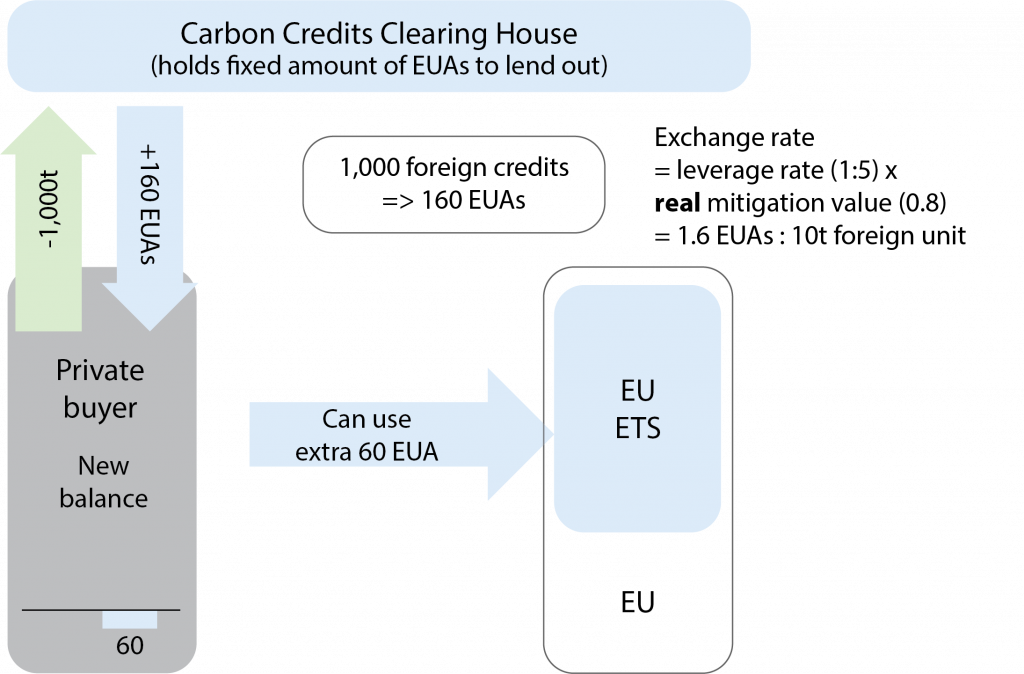
The final mitigation value will be determined in 2040 by the Carbon Buyers’ Club (see section 3.3). For example, if in 2040 it turns out that the country from the example above has achieved 0.4 gigatonnes (Gt) of emissions reductions beyond its baseline and has sold allowances equivalent to 0.5 Gt, its mitigation value would be 0.8 (0.4 Gt/0.5 Gt).
The mitigation value of the country’s credits would be multiplied by the policy-set leverage ratio of 1:5. One EU allowance would thus correspond to 6.25 of that country’s credits (0.8 x 1:5 = 1:6.25). For a company that initially borrowed 100 EU allowances against a collateral of 1,000 foreign credits, the 1,000 foreign credits would then be worth 160 EU allowances (1,000/6.25) and the company would receive 60 additional EU allowances. Figures 2 and 3 illustrate this mechanism.
3.3 Carbon Buyers’ Club
Catalysing global mitigation requires collaboration with other committed countries to avoid substandard trading and to pool leverage. So far, our proposal has addressed how carbon trading could be designed between the EU and those countries that want to make available portions of their national mitigation capacities.
To increase its impact, the EU should engage with partner countries – in the OECD, for example. Some OECD partner countries, such as Switzerland and Japan21, have already begun using international carbon credits under Article 6.2 of the Paris Agreement22.
A Carbon Buyers’ Club could coordinate among those countries that use international credits to meet their own climate targets. It would set common standards for counting international allowances toward domestic climate targets.
In our proposal, the Carbon Buyers’ Club could be involved in determining the baseline for each potential seller country, which would determine the threshold above which emission reductions could be made available for purchase. It would also set out the methodology and possibly the governance system that conducts the final evaluation of each seller country’s mitigation value (reflected in Figure 3).
The Carbon Buyers’ Club could also try to coordinate buyers’ leverage rates to encourage the highest possible global mitigation arising from internation carbon trading. As discussed in Zachmann (2025), a coalition of buyers with sufficient leverage rates could make a substantial contribution to push global emissions closer to keeping global warming well below two degrees.
However, the club should not serve to create unfair buying power in terms of pricing. Each buyer (companies or governments, depending on the model each country chooses) would still compete to buy credits with high expected mitigation values.
Figure 2. Using foreign units as collateral, the CCCH lends domestic compliance units
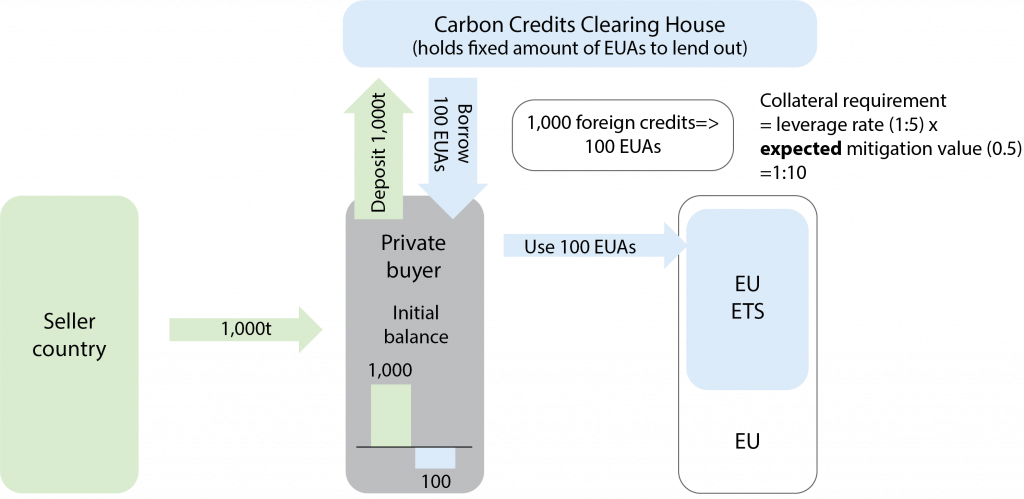
Note: EUA = EU allowance; each EUA is equal to one tonne of carbon dioxide equivalent (CO2e) within the ETS.
Source: Bruegel.
Figure 3. After stocktake evaluation in 2040, private buyers settle their accounts
Source: Bruegel.
4 Conceptual challenges
Our proposal if taken up would mark a significant step away from the international carbon markets that exist in practice and the concepts that have dominated the discussion since the Baku climate summit (COP29). Our proposal suggests three strategic choices:
1. Shifting the issuance of carbon credits away from individual project developers and towards governments;
2. Shifting the purchase of foreign units away from governments and towards private buyers;
3. Applying a leverage ratio that recognises international carbon trading as a strategic lever to encourage greater global mitigation, instead of merely shifting emission reductions from one region to another.
These innovations serve different purposes: first, carbon credits issued at country level could solve many of the integrity, additionality and permanence issues that dog project-based units23. Rather than focusing on hypothetical estimates of emissions that would have existed in the absence of a project, country-level credits would cover emission reductions that will actually be achieved by 2040. Second, private buyers purchasing units could avoid politicisation, efficiently process market information and leverage private finance. Third, a leverage rate would ensure that international transfers result in additional emission reductions, rather than just shifting one unit of mitigation from one region to another.
However, the outlined proposal is not a complete blueprint. Solutions to important political, legal, institutional and technical challenges still need to be found. The European Commission should play a central role in developing a mechanism that will use international flexibilities to encourage substantial additional emission reductions. Based on an ambitious framework, it should explore and negotiate with the main domestic and international stakeholders to find a balanced solution.
The most politically difficult point will be setting baselines for seller countries’ emissions against which improvements are to be sold. Setting the overall budget (broadly implying a maximum warming limit) and attributing it across countries is not a technical question; it is highly political.
A well-below two-degree warming target in line with the Paris Agreement could inform the overall budget. Allocating it could be done based on an indicator that combines different criteria24, ensuring that for each country this compound indicator defines a country-specific baseline that is more ambitious than its current NDC. However, the exact point at which the baseline is set implies decisions on how the financial burden of mitigation should be shared.
This requires a comprehensive assessment of different perspectives and fairness criteria. Setting the baseline also requires careful calibration of the trade-off between ambition and incentives. A too-low baseline risks oversupplying credits and lowering global ambition, while overly ambitious baselines may reduce incentives for countries to engage in carbon trading in the first place25.
A related challenge is how to reflect the impact of leveraged carbon trading in countries’ emissions balances. The proposal implies that emissions in seller countries would decline much more than what they offset in buyer countries. Accounting for this difference in countries’ emissions balances, in the context of the Paris Agreement architecture, requires careful consideration.
Another basic legal question is how to make the proposal compatible with the Paris Agreement and its institutions without requiring unanimous support by all parties to the Paris Agreement. The governance of the Carbon Buyers’ Club and the institutions that assess the final mitigation values and operate the collateralisation and issuance of EU allowances will require thoughtful design.
The proposed architecture also raises institutional and technical questions about the finite time horizon over which the mitigation value of international credits can be assessed. In particular, the allocation of risk requires careful consideration.
If the mitigation value of foreign credits proves lower than expected in 2040, purchasing companies should bear the primary loss, with the CCCH only exposed if firms become insolvent. If domestic carbon prices fall, firms that invested in more expensive international credits may incur losses as well.
On the other hand, if the mitigation value of foreign credits is higher than expected, firms receive additional EU allowances that they can sell or use for domestic compliance (see example in section 3). The system inherently entails a risk for buyers, which policymakers could help mitigate by designing hedging instruments, such as carbon contracts for difference (McWilliams and Zachmann 2021).
Setting up a functioning international carbon market would also benefit from more clarity about the post-2040 period. EU legislation foresees the use of Article 6-type flexibilities only from 2036 to 2040. If this time limitation is maintained, the market will lack the long-term certainty required to develop robust, functional infrastructure.
Conversely, if exchanges of credits successfully support EU policy aims, they might be useful beyond 2040 (as illustrated in section 2.3). Policymakers should already outline how international carbon trading could evolve into a permanent feature of the EU climate policy framework, providing the long-term predictability needed for the market to develop.
These are only some examples of the many legal, political, diplomatic, economic questions that will arise in the preparation, design and implementation of the presented proposal.
5 Conclusion and outlook
The EU’s future use of international carbon credits presents a strategic choice. It can either focus on lowering the cost of domestic compliance, or it can design a tool to strengthen global decarbonisation efforts. But without a pathway towards global emissions reductions, aggressive domestic mitigation risks becoming politically untenable.
To keep climate protection alive, the EU should focus its climate policy on its global impact and design its international credits procurement strategy accordingly.
Achieving this objective requires rethinking how international carbon markets can be organised. Three main conceptual innovations could prove fruitful:
1. Tradable mitigation outcomes should be issued by governments rather than individual projects, linking transfers directly to national mitigation performance and reducing many of the integrity-related challenges associated with project-based crediting.
2. Private companies, rather than governments or EU bodies, should purchase these credits. This would avoid the risk of politicisation, harness market incentives to identify high-quality credits and mobilise private finance for global decarbonisation.
3. The system should include a government-set leverage ratio, ensuring that international flexibility contributes to overall global mitigation rather than merely redistributing existing efforts.
Implementing such a system requires an institutional foundation. Mitigation values linked to countries’ actual performances would provide the basis for valuing international credits. A Carbon Credits Clearing House could bridge the time gap between purchases of foreign credits and final assessments of their mitigation value, allowing companies to use international units for domestic compliance before their full value is known.
Ensuring that Article 6 does not become a loophole for rich countries, but is an instrument to reinvigorate global decarbonisation, relies on the EU not acting in isolation. A multilateral Carbon Buyers’ Club would help facilitate the required coordination. This coalition would empower participating countries to collectively harmonise quality standards, methodologies and leverage ratios, thus safeguarding market integrity against a race to the bottom.
By enabling productive use of Article 6 by a large coalition of buyer countries, the Carbon Buyers’ Club would ensure the integrity of traded credits, thus stabilising the fundamental architecture of the Paris Agreement.
Several political, legal and technical questions remain unresolved, including the determination of country baselines, the governance of the proposed institutions and the finite time horizon. These challenges are substantial but should not obstruct harnessing the broader opportunity.
The EU has about ten years to set up the mechanism and negotiate it with both seller and buyer countries before international carbon credits begin counting towards its emission reductions target in 2036. This period should be used to develop a system that treats Article 6 not simply as a cost-containment instrument, but as an important lever for encouraging additional mitigation efforts.
Endnotes
1. EU emissions dropped from 4.9 gigatonnes of CO2 equivalent in 1990 to 3.2 Gt in 2024, while global emissions increased from 32.2 Gt to 53.2 Gt over the same period (Crippa et al 2025).
2. One example of how the EU has created a mitigation infrastructure is the generous deployment subsidies for renewable energy, which allowed the sector to scale up and contributed to rapid cost declines (Nicolini and Tavoni 2017).
3. See the Council of the EU explainer of 9 January 2026, ‘Europe’s contribution to climate finance (in € billion)’.
4. There is no common terminology for the traded items. For sake of simplicity, we use ‘credit’ for certificates of emission reductions that can be traded across countries. We use ‘allowances’ for EU allowances in the EU ETS, where one allowance corresponds to one tonne of carbon emissions; see European Commission, ‘About the EU ETS’.
5. Reasons for higher marginal abatement costs in developed economies include path dependencies and higher land and labour costs (Glennerster and Jayachandran 2023).
6. For instance, the San José Principles advocated for an Article 6 rulebook that “prohibits the use of pre-2020 [CDM] credits”. See the website of the Government of Costa Rica, ‘About the San José Principles’.
7. By comparison, the finalised Article 6 rulebook permits the use of some pre-2020 CDM credits (Decision 20/CMA.7).
8. The 2023 revision of the EU ETS Directive requires an assessment on shaping the carbon market’s legislative framework beyond 2030 and aligning it with the EU’s 2040 climate target.
9. See European Commission, ‘Call for evidence for an impact assessment: European Climate Law – Climate Action’.
10. See European Parliament, ‘Revision of national targets and flexibilities in the EU climate policy framework’.
11. See European Commission, ‘ETS2, Buildings, road transport and additional sectors’.
12. With one-for-one offsetting, the arbitrage gain is shared between buyers and sellers – buyers because of lower compliance costs and sellers because of additional income. The idea of the leverage ratio implies that the price difference of mitigation outcomes can be utilised to benefit the climate by facilitating additional emission reductions. A political economy challenge is how exactly to set the rate to maximise global emission reductions while still allowing for some reduction in compliance cost.
13. The Paris Agreement Crediting Mechanism (PACM) aims “to deliver an overall mitigation in global emissions” (Paris Agreement FCCC/CP/2015/10/Add.1, Article 6.4).
14. The United States is excluded from this calculation because of its withdrawal from the Paris Agreement, which took effect in January 2026 (CRS 2025).
15. Non-US OECD countries’ emissions were 9.0 Gt. See OECD Data Explorer, ‘Air emissions – Greenhouse gas emissions Inventories’.
16. We use 2036 as the starting point for this calculation because the EU will start using international credits for its own climate targets then (see section 1). We expand the calculation to 2050 to show the potential of the mechanism, despite the fact that the EU Climate Law does not include provisions about the role of international credits post-2040.
17. With a leverage ratio of 1:5, the coalition would offset 15 x 0.45 Gt = 6.75 Gt and stimulate 6.75 Gt x 5 = 33.75 Gt in partner countries.
18. The net global emission reduction would be 33.75 Gt – 6.75 Gt = 27.0 Gt.
19. The estimate is based on an extrapolation that assumes that the current decennial use rate of the remaining 1,150 Gt of carbon budget (2020-2030: 37 percent) will linearly decrease to 0 percent from after 2070 (Zachmann 2025).
20. Collateral requirement = number of borrowed units x leverage rate/expected mitigation value = 100 x 5/0.5 = 1,000.
21. See Swiss Federal Office for the Environment, ‘Bilateral climate agreements’, 21 November 2025; see Ministry of Foreign Affairs of Japan, ‘Joint Crediting Mechanism (JCM)’, 9 April 2026.
22. The division between buyer and seller countries does not have to be static. As seller countries develop, their abatement costs may rise, making sales of carbon credits less attractive. The EU should start the Carbon Buyers’ Club with countries that are potential carbon buyers today and leave open the option for additional countries to join later.
23. The Article 6.4 Supervisory Body and the Methodological Expert Panel have developed a variety of standards addressing some these issues, but international carbon crediting remains fragmented (Fuchs et al 2026).
24. Such as i) per-capita distribution of future budget; ii) per-capita distribution of 1900-2100 budget minus historic emissions; iii) inverse to GDP per capita. On the impact for the EU of different allocation rules, see ESABCC (2023).
25. One way to approach this trade-off could be multiple levels of baselines. Every tonne of carbon mitigated compared to a tight baseline would be accounted for as a full tonne of mitigation, while staying below a looser baseline would only be counted as a fraction of a tonne of mitigation. Again, properly calibrating the set of baselines to maximise incentives and minimise windfall profits requires a defensible methodology.
References
Asadnabizadeh, M and E Moe (2024) ‘A review of global carbon markets from Kyoto to Paris and beyond: the persistent failure of implementation’, Frontiers in Environmental Science 12: 1368105.
Bahí, A, M Fuchs and C Reverdy (2026) ‘Carbon pricing beyond borders: assessing climate policy spillovers from the EU carbon border adjustment mechanism’, Working Paper 05/2026, Bruegel.
Cames, M, R Harthan, J Füssler, M Lazarus, C Lee, P Erickson and R Spalding-Fecher (2016) How additional is the Clean Development Mechanism? Oeko-Institut.
Crippa, M, D Guizzardi, F Pagani, M Banja, M Muntean, E Schaaf … F Pekar (2025) GHG emissions of all world countries, Joint Research Centre, European Commission.
CRS (2025) U.S. Withdrawal from the Paris Agreement: Process and Potential Effects, CRS Report R48504, U.S. Congressional Research Service.
Delbeke, J and J Bencini (2026) ‘The state of carbon credit policy post-COP30’, Policy Brief 2026/01, Florence School of Transnational Governance.
Edenhofer, O, C Leisinger, L Stern and M Kalkuhl (2026) ‘Making international carbon markets work for Europe: Jurisdictional Reward Funds and the EU’s 2040 climate target’, PIK Policy Paper, 16 June, Potsdam Institute for Climate Impact Research.
ESABCC (2023) Scientific advice for the determination of an EU-wide 2040 climate target and a greenhouse gas budget for 2030–2050, European Scientific Advisory Board on Climate Change.
European Commission (2026) ‘Proposal amending Directive 2003/87/EC and Decision (EU) 2015/1814 as regards driving competitiveness and cost-effective decarbonisation’, COM(2026) 616 final.
Fuchs, M, T Mramor and G Zachmann (2026) ‘Buyer beware: a taxonomy of the risks of international carbon credits’, Analysis 17/2026, Bruegel.
Glennerster, R and S Jayachandran (2023) ‘Think Globally, Act Globally: Opportunities to Mitigate Greenhouse Gas Emissions in Low- and Middle-Income Countries’, NBER Working Paper 31421, National Bureau of Economic Research.
McWilliams, B and G Zachmann (2021) ‘Commercialisation contracts: European support for low-carbon technology deployment’, Policy Contribution 15/2021, Bruegel.
Montrone, L, J Leukers, S Jha, S Scholz, A Wehrl and H McDonald (2026) ‘Article 6 credits in the EU ETS 1: Brief assessment of possible integration options’, Discussion Paper 44/2026, German Environment Agency.
Nicolini, M and M Tavoni (2017) ‘Are renewable energy subsidies effective? Evidence from Europe’, Renewable and Sustainable Energy Reviews 74: 412-423.
Pisani-Ferry, J, S Tagliapietra and G Zachmann (2023) ‘A new governance framework to safeguard the European Green Deal’, Policy Brief 18/2023, Bruegel.
UNEP (2025) Off Target, Emissions Gap Report 2025, UN Environment Programme.
Zachmann, G (2025) ‘A Strawman Proposal to Use International Flexibility in Achieving Developed Countries Climate Targets to Catalyse Global Decarbonisation’, The Economists’ Voice 22(2): 339-348.
The authors thank Maximilian Fuchs, Flora Marchioro, Alexander Roth, Simone Tagliapietra and the participants in the Bruegel roundtable on international carbon trading on 18 June 2026 for their helpful comments. This article is based on Bruegel Policy Brief Issue no16/26 | April 2026.