
Supercharging AI into explosive growth
Tom Davidson, Basil Halperin, Thomas Houlden and Anton Korinek
Frontier artificial intelligence (AI) labs like Anthropic and OpenAI have explicitly stated that they plan to use their AI models to develop their next models, beginning a process of ‘recursive self-improvement’. Over time, this may trigger an ‘intelligence explosion’ as capable models develop even more capable models. If such abundant intelligence is deployed throughout the economy, it may give a tremendous boost to both technological advancements outside of AI and the production of goods and services in the broader economy.
The concept of an intelligence explosion is not new. In 1966, mathematician Irving J Good wrote that “an ultra-intelligent machine could design even better machines; there would then unquestionably be an ‘intelligence explosion’, and the intelligence of man would be left far behind.”
Yet despite the significant economic implications of such a process, economists have been slow to take the possibility seriously. Aghion et al (2019) develop a simple economic environment to re-examine Good’s assertion. Suppose a machine’s capability grows at a rate that depends on how much capability it has already accumulated, with a single parameter governing the returns to scale of that process. If returns are decreasing — each further increment of capability is harder to win than the last — growth decays toward zero. If returns are increasing, capability diverges to infinity in finite time: an intelligence explosion.
In practice, that parameter may reflect several competing forces. If ideas are getting harder to find, that pushes towards decreasing returns. However, a sufficiently capable machine may conduct research that improves its own capabilities, pushing the other way, and potentially far enough to tip the balance. Whether an explosion occurs therefore depends on which force wins: the drag of diminishing returns or the push of recursive self-improvement.
There have been significant developments in AI in recent years, which help provide a richer view of the intelligence explosion than the single ordinary differential equation offered by Aghion et al (2019). In particular, ‘scaling laws’ suggest that increases in training compute deliver predictable improvements to AI capabilities.
Extrapolating these laws, AI labs have made significant investments in AI chips, with the total stock of compute having doubled every seven months since 2022 (Epoch AI 2026). This ramping up of investment has occurred against the backdrop of predictable technological progress in the capabilities of these chips over the last 60 years (‘Moore’s Law’), meaning more computing power can be purchased for less.
Algorithmic progress has also contributed to AI capabilities, implying that the training compute required to reach a given level of model performance has declined by about two-thirds per year since 2012 (Ho et al 2024).
Given these trends, economic models of AI progress need to account for the growth in the inputs of both compute and software, as well as the distinct research efforts and investment that determine compute stocks and algorithmic progress.
In a recent paper (Davidson et al 2026), we develop a framework for understanding the transformative future potential of AI by demonstrating how this technology may establish new feedback loops in the economy. Imagine that AI is powerful enough to perform 20% of tasks in each sector of the economy that used to be performed by workers — including in research.
Adding a stock of ‘AI workers’ could then increase output both directly — by performing the work required for the production of goods and services — and indirectly — by supporting research and development, ultimately increasing economic productivity. Further, increases in output can then be reinvested in more compute to run and train these AI systems, leading to greater abundance of AI inference as well as better models.
The question of an intelligence explosion can no longer be dismissed as science fiction – it has become a question of parameters
Additionally, there may be a recursive self-improvement feedback loop whereby AI workers can support AI researchers, as well as researchers working on designing more efficient computing hardware. Thus, AI progress may drive additional AI progress. This shift to an economy where ‘AI labour’ can accumulate through investment is stylised in Figure 1.
Figure 1. AI labour accumulation
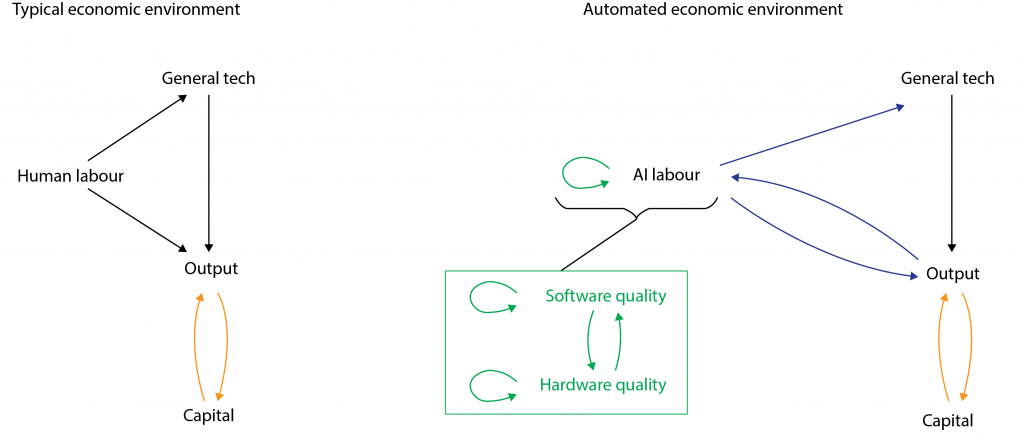
The stylised environment above starts with an initial world on the left where ‘feedback loops’ only occur between capital and output: more output means we can save more to increase the supply of productive capital, which in turn can be used in the production of output.
However, diminishing returns to capital mean that this environment only permits a stable balanced growth path, not explosive growth. In the automated economy on the right, however, feedback loops are established in many new places, facilitated by AI which allows capital to replace labour in some tasks.
This automated economy exhibits explosive growth when there are increasing returns, ie. when for every dollar the economy allocates to running AI models, it ultimately returns more than a dollar in output. In this environment, economic activity may involve making products, providing services, performing, say, biomedical research, or, of course, researching to develop more advanced AI models.
The question then becomes: what are the conditions in the automated economic environment that permit increasing returns? In our recent paper we attempt to answer this question in a simple environment that integrates the described feedback loops into a macroeconomic model.
We show that in this environment, the only information needed to determine whether the system is explosive is i) the labour share in the economy today, ii) the degree of diminishing returns in technology sectors such as AI algorithms and computing hardware, and iii) the share of tasks in each sector of the economy that are automated. Given estimates of the returns to research effort from Bloom et al (2020) and Ho et al (2024), we can calibrate this condition. Several insights emerge.
First, if the task bundles across all sectors in the economy are automated equally, the share of tasks that need to be automated to achieve explosive growth is only 13%.
Second, the historical degree of diminishing returns in the hardware sector is much lower than in other sectors. In particular, automating a task in the hardware research sector has about ten times the impact on achieving explosive growth as does automating a task in the production of final goods.
Third, the growth effects of automation are highly convex. The model indicates that 8% of tasks need to be automated in order to double the balanced growth path of output. This is most of the way to the 13% threshold for fully explosive growth.
Although 13% task automation may seem surprisingly low, this figure rests on several important simplifying assumptions. Following Zeira (1998), we assume Cobb-Douglas aggregation of the outputs of tasks completed by AI and human workers. This rules out the possibility that output is bottlenecked by slower growth in the tasks only humans can perform.
By contrast, in an economy with such bottlenecks, automation would generate ‘endogenous dampening’: large stocks of AI-equivalent workers would simply drive down the elasticity of output with respect to those workers, causing AI-induced growth to trail off (Jones and Tonetti 2026).
We believe bottlenecks of this kind are an important feature of the economics of AI. However, we also show that sufficiently fast automation of new tasks can offset the drag associated with endogenous dampening, thus leaving explosive growth on the cards.
Additionally, even if growth dynamics are explosive, when the strength of feedback links is close to the explosion threshold, it may take many decades before output diverges to infinity. That said, in one illustrative back-of-the-envelope calibration — which abstracts from the bottlenecks discussed above — full software automation in conjunction with a small fraction of automation throughout the rest of the economy could deliver a singularity within six years.
Sixty years after Good’s conjecture, the question of an intelligence explosion can no longer be dismissed as science fiction – it has become a question of parameters. Our analysis suggests that the conditions for explosive growth are less demanding than intuition might suggest: modest levels of task automation, particularly in the research sectors that produce better algorithms and better chips, can tip the economy into a regime of increasing returns.
To be clear, this is a statement about possibility. Bottlenecks from tasks that remain stubbornly human, physical constraints on building compute, and the pace at which new tasks can be automated will all shape whether and how fast these dynamics materialise. But the mechanisms are now concrete enough to measure: the labour share, the returns to research effort, and the automation share are all observable.
Economists have historically treated explosive growth as a curiosum at the edge of growth theory. But this is changing: in a recent statement of which all four of us were initial co-signatories (Digital Economy Lab 2026), more than 200 economists and technology leaders — including more than a dozen Nobel laureates — called on the profession and policymakers to “act now to understand the economics of transformative AI” and to build the institutions needed to steer it.
Our results underscore why the urgency is warranted: the preconditions for explosive growth are observable and measurable, and may already be in motion.
ABOUT THE AUTHORS
Tom Davidson is a Senior Research Fellow at Forethought, Basil Halperin is a PhD candidate in economics at the Massachusetts Institute of Technology, Thomas Houlden is a PhD candidate in economics at Columbia University, and Anton Korinek is Head of Transformative AI Economic Studies at Anthropic Institute
References
Aghion, P, BF Jones and CI Jones (2019), “Artificial Intelligence and Economic Growth”, in A Agrawal, J Gans and A Goldfarb (eds), The Economics of Artificial Intelligence: An Agenda, University of Chicago Press: 237–282.
Bloom, N, CI Jones, J Van Reenen and M Webb (2020), “Are Ideas Getting Harder to Find?”, American Economic Review 110(4): 1104–1144.
Davidson, T, B Halperin, T Houlden and A Korinek (2026), “When Does Automating AI Research Produce Explosive Growth? Feedback Loops in Innovation Networks”, NBER Working Paper No. 35155.
Digital Economy Lab (2026), “We Must Act Now: A Statement on AI’s Transformation of the Economy”, Stanford University, 13 July.
Epoch AI (2026), “Global AI Computing Capacity Is Doubling Every 7 Months”, Epoch AI Data Insights, published online at epoch.ai.
Good, IJ (1966), “Speculations Concerning the First Ultraintelligent Machine”, Advances in Computers 6: 31–88.
Ho, A, T Besiroglu, E Erdil, D Owen, R Rahman, ZC Guo, D Atkinson, N Thompson and J Sevilla (2024), “Algorithmic Progress in Language Models”, Advances in Neural Information Processing Systems 37 (NeurIPS 2024).
Jones, CI and C Tonetti (2026), “Past Automation and Future A.I.: How Weak Links Tame the Growth Explosion”, working paper, Stanford GSB and NBER.
Zeira, J (1998), “Workers, Machines, and Economic Growth”, Quarterly Journal of Economics 113(4): 1091–1117.
Authors’ note: Anton Korinek is currently on leave from the University of Virginia and works at the Anthropic Institute, where he heads Transformative AI Economic Studies. This column is based on research performed while he was at the University of Virginia. This article was originally published on VoxEU.org.