
Better regulation in the EU needs a fresh start
Anne Bucher is a Non-Resident Fellow at Bruegel, and Elizabeth Golberg was formerly Director of Better Regulation in the European Commission
Executive summary
Despite having developed a comprehensive and highly rated regulatory policy system (so-called ‘better regulation’), involving consultation, impact assessments, evaluation, inter-institutional commitment and independent oversight, the European Union continues to face criticism for the volume, complexity, costs and administrative burden of its laws. This raises the question of whether something is wrong with the better-regulation system, or whether the EU institutions have failed to adequately apply the system.
In fact, the system is robust but there are weaknesses in its application. There is no evidence that burden-reduction programmes or attempts to stem the ever-increasing flow of legislation have had desired effects. There are significant exceptions to the application of better regulation tools, including simplification efforts under the second Ursula von der Leyen Commission. Meanwhile, few assessments are conducted on legislative amendments approved by the European Parliament and the Council of the EU. The quality of assessments, particularly ex-post evaluations is wanting.
Several steps could be taken to overcome these weaknesses. On the ever-increasing flow, political control could be strengthened by a dedicated Better Regulation Commissioner, the development of new conditions for preparing new laws and adoption of systematic regulatory pauses at the end and beginning of each Commission term. On coverage, the Council and the Parliament need to conduct assessments of their amendments. This could be facilitated through an inter-institutional mechanism using the initial impact assessment’s methodology. Given that they involve trade-offs and costs, some secondary legislation needs to be assessed in a proportionate manner.
The quality of assessments could be improved by establishing a centre (or centres) of analytical expertise. This would build and continuously update a robust evidence base for policy areas. It could help streamline the analytical demands for impact assessments. Ex-post evaluations are key to improving the implementation of EU law. Externalising ex-post evaluations could improve their quality and facilitate better assessment of implementation gaps.
In an increasingly complex, volatile and polarised political environment, better regulation is essential. The tools need to be applied consistently to support the policymaking process.
1 Introduction
“The regulatory burden on European companies is high and continues to grow…. The [European] Commission has been working for years to reduce the ‘stock’ and ‘flow’ of regulation under the Better Regulation agenda. However, this effort has had limited impact so far. The stock of regulation remains large and new regulation in the EU is growing faster than in other comparable economies.”
This extract, from the report on European Union competitiveness produced in 2024 for the European Commission by former prime minister of Italy Mario Draghi (Draghi 2024), could have been written at any point in the last twenty-five years. The EU has long been criticised for producing too many ill-conceived, costly laws.
In addition, implementation of EU law is patchy, with EU countries slow to write EU law into national statutes and slow to comply with the law. Countries also often add additional requirements to EU law – so-called gold plating. All of this contributes to continued and growing concern about EU regulation and its dampening effect on investment and innovation in the EU (Draghi 2024; EIB 2025; Eurochambres 2025; Letta 2024).
In response, over the past quarter century, the Commission has prioritised ‘better regulation’ (ie. impact assessment, stakeholder consultation, evaluation, quality control) aimed at improving the quality of legislation and its implementation. Results have been mixed. In this context, European Commission President Ursula von der Leyen announced in 2025 a further set of ‘better regulation’ measures, involving simplification, reduction of administrative burden and regulatory budgeting (European Commission 2025a).
These actions may be worthy but they closely resemble previous initiatives1. This begs the question of whether they will lead to the desired improvements, or whether a more radical shift in approach is needed. Answering this question requires an evaluation of the better regulation system to assess what has worked, what has not worked and why. This paper sets out some ideas that could feed into such an assessment. It reviews the better regulation system (section 2), identifies shortcomings (section 3) and suggests how they might be overcome (section 4).
2 What is ‘better regulation’?
Improving the quality of laws and reducing costs and red tape have been political priorities for the European Commission since the early 2000s2. The Commission’s regulatory policy approach aims to prepare and adapt EU policy and legislation with knowledge of its expected economic, environmental and social impacts, avoiding unnecessary burdens and minimising costs and red tape for citizens, businesses and public authorities.
To do this, different tools are applied at each stage of the policy cycle. Strategic planning is used to manage the flow of new initiatives, making sure that they are supported by impact assessment and ex-post evaluations (for amendments to existing law). Impact assessments set out options and analyse the economic, social and environmental impacts of proposed measures.
Ex-post evaluation keeps the stock of law under review, assessing it for effectiveness, efficiency, relevance and coherence. REFIT (Regulatory Fitness) exercises have been introduced to examine these aspects within and across policy areas. Stakeholders are consulted on both new and existing legislation via public or targeted consultations. Stakeholders can comment along the decision-making chain (European Commission 2021a).
Improving the stock of legislation has involved target-setting for the reduction of administrative burden (European Commission 2007), regulatory budgeting (European Commission 2021a), simplification and regulatory stress testing (European Commission 2025a). Expert groups have provided advice on burden reduction since 20073. The complexity and volume of legislation is also reduced through withdrawals of proposals, repeals, codification (by which all amendments of a law are incorporated into a single new act) and recasting (all previous amendments are incorporated in a new text when the law is amended).
Impact assessments and evaluations (including REFIT exercises) are subject to independent quality control by the Regulatory Scrutiny Board (RSB)4. The European Parliament and Council of the EU (at working-group level) also scrutinise the Commission’s impact assessments to advise parliamentary committees and Council working groups when they discuss Commission proposals. The regulatory policy system has been evaluated by the European Court of Auditors (ECA 2018, 2020).
In finalising EU laws, the Council of the EU and the European Parliament have important roles to play in better regulation. Under an Inter-Institutional Agreement on Better Law Making in 2003, revised in 20165, Council and Parliament committed to examining Commission impact assessments and conducting their own if they make significant amendments to Commission proposals. The institutions agreed that a systematic approach to evaluation is required, and that all new legislation should include provisions on monitoring and evaluation.
Commission ex-post evaluations of legislation are weak, often ill-timed, of mixed quality and with questionable impact
3 Why is the better-regulation system still perceived as falling short?
The Commission’s regulatory policy system is complete in that the necessary policy development tools (impact assessment, consultation, evaluation, oversight) are in place and are highly rated6. Yet the Commission’s application of better regulation has not managed to stem criticism of the flow (too voluminous), quality of assessments (variable) and management of the stock (large and sometimes incoherent) of EU legislation (Draghi 2024; Herby 2024; Kaufmann 2025; Letta 2024; Marcus 2024; Marcus and Sekut 2024). The following subsections outline some of the reasons why this might be the case.
3.1 The volume of legislation continues to increase
The number of EU laws has steadily increased. There are different ways to calculate the growing volume of legislation (total number of acts, total number of pages or words; Marcus, 2024; Herby, 2024). All metrics point to an increasing number of Commission proposals in each term and continued high rates of adoption of new laws. Under President Ursula von der Leyen, the Commission has opted for regulatory budgeting to control the flow, but the ever-increasing numbers of proposals shows that this has had no effect.
Table 1. Commission proposals and adopted acts under ordinary legislative procedure
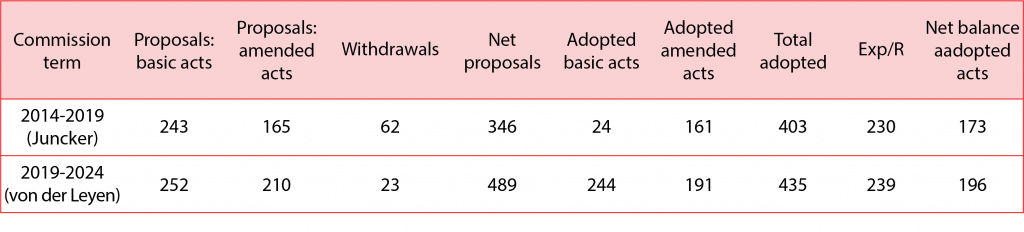
Note: Exp/R = expired and repealed acts; Balance adopted = total adopted legislation less expired and repealed acts.
Source: Bruegel based on EURLEX.
Table 1 shows two measures of the net flow of legislation: 1) the number of Commission proposals less withdrawals, and 2) the number of adopted acts less repeals. Withdrawals and repeals are not keeping pace with new proposals and adopted acts, with the result that the net volume of legislation continues to increase.
Withdrawals are normally of proposals that stand no chance of being adopted, or that have been overtaken by events or supplanted by other legislative proposals and usually happen at the start of a Commission term, when the new executive decides whether to continue with unfinalised proposals made by the previous Commission (so-called discontinuity). Repeals are more numerous, usually of a housekeeping nature, covering decisions with a fixed period of validity.
Secondary legislation (delegated acts, which supplement or amend non-essential elements of EU laws, and implementing acts, which execute policy by establishing uniform conditions for applying the laws) is voluminous. The number of delegated acts has increased by even larger margins under the first von der Leyen Commission compared to that of President Jean-Claude Juncker (2014-2019).
This reflects a trend in the design of primary legislation towards prescriptive detail, with technical specifications being set out in subsequent delegated or implementing acts. This exacerbates the perception, especially among businesses, that EU rules are ever-increasing, detailed and costly (BusinessEurope 2022).
Table 2. Delegated and implementing acts under ordinary legislative procedure
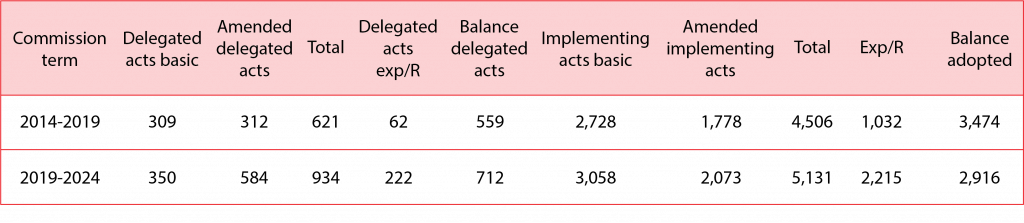
Note: Exp/R = expired and repealed acts; Balance adopted = total adopted implementing acts less expired acts and repeals.
Source: Bruegel based on EURLEX.
3.2 Major proposals are increasingly accompanied by impact assessments but there are significant exceptions
In recent years, about 60 percent of Commission proposals that go through the ordinary legislative procedure7 have been accompanied by impact assessments (Table 3). However, proposals made during emergencies (including the war in Ukraine, COVID-19, spikes in illegal migration and financial crises), delegated and implementing acts, and legislative amendments escape the discipline. For example, during the COVID-19 pandemic (2019-2020) only 5 percent of Commission proposals were accompanied by an impact assessment (Council of the EU 2023).
Ironically, none of the recent simplification initiatives have been accompanied by an impact assessment (Box 1). This surprising disregard for the better-regulation rules, led to complaints to the European Ombudsman (2025), which has admonished the Commission for using the derogation from better-regulation requirements for urgent matters without proper justification and for failing to adequately consult internally and externally.
Few impact assessments have been done for delegated and implementing acts8. This is concerning given that, although technical, such acts can involve political judgement, trade-offs and costs (Robert 2019). The Commission itself has identified these acts as potentially contributing to overregulation (European Commission 2025a)9.
A major gap in application of better-regulation practice concerns amendments put forward and adopted in the EU co-decision process, in which the Council of the EU and the European Parliament debate and adopt legislation. Neither the Council nor the Parliament have managed to conduct more than a handful of assessments of their amendments to Com-mission proposals (Hiller 2024; Council of the EU 2023).
Adopted laws may thus have significant impacts not foreseen in the Commission’s impact assessment. This, combined with choices made by EU countries in implementing EU legislation, can result in increased costs, unexpected impacts or incoherence between laws, which were not foreseen in Commission impact assessments.
Table 3. Commission proposals and impact assessments
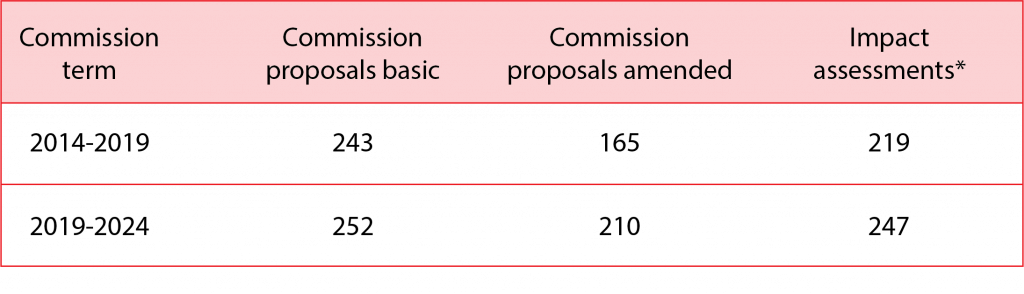
Note: * impact assessments reviewed by the RSB.
Source: Bruegel based on EURLEX.
Box 1. Why the quality of impact assessments matters: the example of ‘Omnibus I’
Some of the shortcomings in impact assessments were reflected in the preparation and aftermath of adoption of two EU corporate governance and reporting laws, the Corporate Sustainability Reporting Directive (CSRD, Directive (EU) 2022/2464) and the Corporate Sustainability Due Diligence Directive (CSDDD, Directive (EU) 2024/1760). Both were included in the European Commission’s so-called Omnibus I package of February 202510 – the term ‘omnibus’ describing a streamlining and simplifying of rules. This postponed the implementation of some provisions of the CSDDD by a year and amended the CSRD.
When these directives were proposed – the CSRD in 2021 and the CSDDD in 2022 – the proposals were supported by impact assessments. However, in both cases, the Regulatory Scrutiny Board warned of weaknesses in the impact assessments (European Commission 2021d, for CSRD, and European Commission 2022, for CSDDD), particularly:
Weak justification of the need for legislation;
Unclear content and unsubstantiated impacts;
Proportionality issues, including a lack of analysis of impacts on SMEs, and of options other than legislation as a preferred instrument;
Incoherence between legislation, such as non-aligned thresholds for reporting and due-diligence requirements, which make compliance costly, and the coexistence of sectoral and general legislation, resulting in overlaps and duplication of obligations;
‘Gold plating’ of international rules, ignoring the need for consistent EU and international reporting standards.
The initial CSRD proposal received a positive opinion with reservations from the RSB. The CSDDD went ahead despite receiving two negative opinions. With the Omnibus I package, the Commission responded to stakeholders’ demands for simplification. The amended CSRD would alleviate reporting requirements, exempt SMEs and other smaller companies, align the size threshold with that of the CSDDD and adopt a simpler reporting standard for large companies11. The initial RSB opinion had identified these three issues as raising problems of proportionality and coherence of the proposal with other legislation.
In a review of the Omnibus I proposals, Marcus and Thomadakis (2025) acknowledged that the scope and coverage set out in the initial package may have been overly ambitious and disproportionate and welcomed corrections: “the legislative proposal’s attempt to simplify compliance and to better align the three laws is directionally right, but a quick analysis in the absence of a proper impact assessment necessarily struggles to verify the appropriateness of the specific measures being put forward” (Marcus and Thomadakis 2025, p54). The authors made a number of recommendations to make future decisions more robust.
The Commission in 2025 issued eight omnibus proposals overall covering various fields: sustainability, InvestEU, agriculture, small mid-caps and digitalisation, defence, digital, chemicals and environment12. All were published after limited consultations and without an impact assessment for reasons of emergency and political importance.
This sidestepping of better-regulation rules has led to widespread criticism about the simplification agenda, including from academics (Alemanno 2025) and civil society via the European Ombudsman (2025). Analysis of the individual proposals points to serious concerns about quality issues in the proposed legislation13.
3.3 The quality of analysis is variable
Impact assessments are the bedrock of the better-regulation system, shaping the quality of the Commission’s legislative proposals. However, there are recurring problems in impact assessments (Box 1), with the RSB delivering negative opinions on about 40 percent of impact assessments submitted to the board (European Commission 2023). The RSB has identified problem definition and the assessment and comparison of options as major shortcomings. Proportionality is also an issue (European Commission 2023).
As for examining a range of options, it is important to note that the impact assessment process does not always start with a blank sheet of paper. The preferred policy option is often prescribed in either Council of the EU conclusions or European Parliament resolutions. The same limitation applies when the EU enters into binding international agreements that must be transposed into EU law. In both cases, options are circumscribed.
Quantification of costs and benefits, a concern often raised by stakeholders, is improving. However, the RSB indicates that on average only 40 percent of impact assessments estimate costs fully, while benefits are quantified even less (European Commission 2023).
More broadly, meeting the ever-increasing number of consultation and analytical requirements in the better-regulation system – one-in-one-out cost-benefit calculations, SME tests, competitiveness assessments, compliance with climate goals, digital-by-default, no net harm, strategic foresight, reality checks, stress testing – is challenging and resource intensive.
Impact assessments have become voluminous, easily running to hundreds of pages. The question arises of whether the quality of essential analytical elements has suffered because so many additional requirements have been added.
3.4 Efforts to improve the legislative stock are falling short
Commission ex-post evaluations of legislation are weak, often ill-timed, of mixed quality and with questionable impact on further policy development (European Commission 2024; ECA 2018). They lack evidence and relevant data and often have limited stakeholder input. The RSB scrutiny comes too late in the process to improve data collection or methodology. For amendments to existing legislation, the RSB (European Commission 2024) has indicated that only up to a third of ex-post evaluations are of sufficient quality to inform the associated impact assessment.
Even in the case of good ex-post evaluations, there is a hesitation to follow up on recommendations if they entail reopening discussions on laws (for example, environment, chemicals and food safety law) that were adopted following long, tense and divisive negotiations, or which are only in the process of being fully implemented.
More fundamentally, as EU countries and not the Commission are responsible for implementation, there is a tendency to give evaluation a low political profile and to resist calling into question the performance of legislation and programmes.
Stakeholders continue to highlight the inconsistencies and contradictions in different pieces of legislation across policy areas (BusinessEurope 2025). Fitness checks were introduced to look at coherence between pieces of legislation and policy fields (European Commission 2012). But the problem remains (European Commission 2021c).
The costs of EU law are significant14. Efforts to reduce costs through targets and regulatory budgeting have not brought desired relief for stakeholders and business. These exercises focus on estimated cost reductions embodied in Commission proposals. Such savings are not tracked and may or may not make it through the legislative process.
Furthermore, experience points to an additional difficulty of timing. Often, cost-reduction measures come into effect so long after their announcement and calculation that the beneficiaries do not feel or register the savings15. Furthermore, when reduction efforts focus on legislation in the pipeline, the results provide some relief in the sense that additional burdens are avoided. But such exercises do not directly tackle problems of the cost of existing laws.
4 Policy recommendations
Can the current better-regulation system deliver quality, timely analysis in an increasingly complex, multi-level governance context, subject to frequent crises? Yes, but changes are needed to meet the challenges of a complex policymaking landscape characterised by rapid technological change and volatility.
4.1 Recommendation 1: legislative flow
If the flow of legislation is to be reined in, the European Commission needs to make a high-level commitment to better regulation, with a designated commissioner (Vice President for example) with the authority to exercise discipline and restraint in making proposals, simplify where possible and ensure coherence between policy areas.
The European Commission has the right of initiative and full discretion to decide on the volume of the flow of legislation. Political control of the flow requires a commissioner to be given a clear mandate by the president to control the flow, ensure quality proposals that are coherent across policy areas and manage the legislative stock.
So far, this responsibility has been an add-on to another portfolio (for example economy and productivity under the current Commission, inter-institutional affairs under the first von der Leyen Commission from 2019-2024).
Given the seriousness of the problem of regulatory overload, it would seem appropriate to have the responsibility for better regulation (from strategic planning through impact assessment, consultation, evaluation and implementation) in a dedicated single mandate.
To manage the flow, the responsible Commissioner could introduce new metrics and conditions for inserting proposals into the Commission Work Programme (eg. demonstrable results in implementation of existing legislation). S/he could be charged with reining in the use of secondary legislation and systematically assessing whether reliance on principles-based primary law with technical specifications set out in delegated and implementing acts is the best approach.
S/he could initiate a discussion on systematic application of the principle of discontinuity with the other institutions and on strengthening the existing practice of a regulatory/legislative proposal pause at the end and beginning of each Commission mandate.
Importantly, this Commissioner would be charged with examining whether regulation (often the default instrument) is the right approach to problem solving, or whether soft instruments or other approaches might be better options.
Finally, given that policy is made in a rapidly changing and uncertain world, the Commissioner could be charged with developing an adaptive approach to regulation, with shortened feedback loops, more consultations and real real-time input from reviews and evaluations.
4.2 Recommendation 2: assessment throughout the legislative process
Set up an inter-institutional mechanism to assess amendments proposed during the co-decision process, to ensure methodological consistency with Commission impact assessments and to conduct post-adoption assessments.
Given the dearth of assessments of amendments to laws made by the Council and the European Parliament, there is a need not only for a reinforced commitment by all the EU institutions to better law making, but a new inter-institutional mechanism to translate this commitment into action.
This mechanism should assess the impact of amendments using the Commission’s impact assessment methodology. It should also identify how the impacts of adopted laws differ from those foreseen at the proposal stage. This would also help in better informing EU countries when they make implementation choices. The mechanism could examine stakeholder comments on Commission impact assessments following their publication, to see if any revision of methodological approach is needed.
4.3 Recommendation 3: assessment of delegated and implementing acts
More systematic, but proportionate, assessment of the costs of delegated and implementing acts.
Delegated and implementing acts need to be better assessed, in a proportionate manner. Because of their technical nature and limited scope, there is no need to do full impact assessments or full cost-benefit analyses. Cost assessments should suffice.
Thought needs to be given to what might be an appropriate trigger for such an assessment. A quantitative monetary threshold could be used. Or, given that draft acts are published for feedback, the number of concerns raised during the consultation could prompt an assessment.
4.4 Recommendation 4: professionalisation through establishing a centre of analytical expertise
Establish an internal centre of analytical support as the dedicated centre for regulatory analysis (including cost/benefit, modelling and use of artificial intelligence) for all impact assessments and for validation of impact assessments and ex-post evaluation methodologies.
The quality of better-regulation outputs depends in part on the soundness of the methodology employed. The Commission faces increasing and insatiable demands to better calculate costs of proposals and of legislation in force. This has resulted in a spawning of new analytical requirements within the system – administrative cost calculations, cumulative cost calculations – aimed at meeting targets and complying with regulatory budgets.
Draghi (2024) suggested that one cost calculation method be used. But experience has shown that while some assessments lend themselves to standard cost/benefit analysis, others don’t. The standard cost model, to which Draghi (2024), referred covers administrative costs which, while important, are a small portion of total costs (including compliance, one-off investment costs, payroll and taxes).
This raises the question of the usefulness of focusing regulatory policy efforts on the measurement and reduction of a small sub-set of costs and, indeed, whether it is useful at all to look at costs in isolation without measuring benefits.
Draghi (2024) also suggested that the choice of one methodology would make it possible to calculate the aggregate cost of EU legislation. However, given the differences in methodological approach across assessments combined with data issues, there is neither enough consistency nor accuracy to facilitate meaningful aggregation of either costs or benefits across policy areas16.
There is no methodological silver bullet. The use of standard tools, such as the administrative burden calculator, has stood the test of time. There have also been several successful cases in which impact assessments have been effective in informing policymaking and which could serve as models of methodological excellence (Box 2).
These show how major sensitive policy debates in the EU have benefited from extensive consultations and consistent and comprehensive analyses that accurately reflect policy trade-offs. There is a need to move away from ad-hoc evidence collection for specific impact assessments or ex-post evaluations. New ways should be explored to ensure quality and consistency between analyses, foster and maintain data and evidence bases, and introduce artificial intelligence tools.
Cases in Box 2 show the merit of centralising analytical work for major policy areas to develop and maintain a solid evidence base. The centre could develop baselines (using projections, market intelligence and scenarios), examine costs of inaction and collect evidence on implementation (systematic and continuous data collection, consolidation of consultation outcomes, use of AI tools).
Various possibilities for establishing such a centre could be explored: establishing a new centre (involving consolidation and grouping of resources in all the institutions dedicated to analytical tasks), reinforcing the role of the Joint Research Centre, and/or, using a framework similar to Science Advice for Policy by European Academies (SAPEA)17 to tap into complementary academic expertise.
Box 2. Examples of impact assessments based on a comprehensive and consistent analytical framework
Climate change
Europe has been among the climate policy leaders for several decades. Building consensus on climate change has been difficult and the consensus would not have been achieved without a convincing and transparent impact assessment process.
Since 2007, the European Commission has put in place a solid knowledge base combining a comprehensive set of quantitative instruments (European Commission, 2021b). These include a suite of general equilibrium models and sectoral models: a model for the macro linkages between energy and environment (GEM-E3), a model for energy (PRIMES) – including energy efficiency – for transport (PRIMES-TREMOVE), for land use and forests (GLOBI-OM-G4M), a model for the linkages between climate change and environment (GAINS) and a model for agriculture (CAPRI). All models are now available in the Modelling Inventory and Knowledge Management System (MIDAS) of the European Commission’s in-house Joint Research Centre (JRC)18.
This suite of models guarantees consistency between greenhouse gas emission reduction targets, the market instruments to achieve them, efficient distribution of sectoral contributions and a fair distribution of efforts among EU countries. It relies on a common baseline, the EU reference scenario 2020 (European Commission 2021b), which projects economic and technology trends based on national policies.
It has been designed with and validated by EU countries. The analytical framework also provides time consistency of climate change policies since the framework was used throughout the years for the 2020 package, the 2030 package and the European Green Deal milestones, including the Fit for 55 package and climate neutrality by 2050.
The system has policy monitoring and evaluation provisions that require EU countries to assess in real time the outcome of national policies in relation to the objectives.
Climate change remains a divisive issue and the policy has not been successful in all areas. But overall, the EU has put in place ambitious packages, delivered on their objectives and implemented timely changes or new mechanisms to correct deviations from the agreed trajectory. The robustness of the analytical framework used for the impact assessment played a major role in this process19.
Common Agricultural Policy (CAP)
Similar developments have occurred in the CAP over the last 25 years. As with climate change, the need for a robust empirical foundation was driven by the heated debate about European support for agriculture. Efforts have focused on both ex-post evaluation and impact assessment. For the 2014–2020 programming period, a Common Monitoring and Evaluation Framework was established to organise harmonised and granular data collection.
This was complemented by a Performance Monitoring and Evaluation Framework (PMEF) for 2020–2027. Impact assessments for these two programming periods (European Commission 2018) could draw on various monitoring and evaluation exercises. As with climate change, a baseline calibrated against international scenarios was built on the basis of the European Agricultural Outlook (European Commission 2025b).
The Treaty objectives for the CAP are numerous, including increased productivity, improved standards of living for farmers, market stability, food security and affordability. Models have been used to illustrate various economic, social and environmental trade-offs. For 2020-2027, seven models20 were combined to test various reform options, ranging from a global sectoral general equilibrium model (MAGNET) to specific tools for modelling soil quality (IFM-CAP) and carbon and nitrate dynamics (CENTURY), as well as the national agricultural sectors of EU member states (CAPRI), a database containing 86,000 individual farm-level accounts (AIDSK). This work benefitted from the consolidated expertise of the JRC, Eurostat, the OECD and the United Nations Food and Agriculture Organisation.
Not all policy areas lend themselves to such modelling systems. But efforts on systematic data collection over time, scenario analysis, validated baselines with EU countries and international organisations, and internalisation of databases and tools are relevant practices that could make impact assessments and ex-post evaluations more robust. They also have organisational implications: they can mitigate the silo approach in policymaking; they also offer broad scope for collaboration across levels of governance: EU, national and international.
4.5 Recommendation 5: streamlining and simplifying analytical requirements
The Commission should consolidate and streamline the various analytical requirements.
The capacity of Commission departments to cope with the ever increasing analytical and consultation demands within the better-regulation system is being seriously tested.
The creation of a centre for analytical support and the use of AI may assist in meeting these requirements. Nonetheless it is an open question as to whether the fundamental aim of these instruments – informing decision making – could be met in a more streamlined, effective manner.
Without sacrificing meaningful consultation or analytical rigour, some streamlining, consolidation and prioritisation of the requirements relative to the type of proposals under development could lead to qualitative improvements.
For example, in most cases, following an initial scoping, the number of realistic options is clear. The impact assessment could then zero in on the three original areas of focus: economic, social and environmental impacts. If the expectation is that intended action would have significant impacts on a particular sub-area of these areas (eg. on climate change, biodiversity, SMEs or competitiveness), further in-depth analysis of the specified area would be necessary.
Importantly impact assessments should spell out the main policy trade-offs, such as competitiveness versus health benefits, and demonstrate how various options perform in these respects. Meaningful consultation should help to signal impacts that might have been overlooked. The aim is to avoid box-ticking exercises that cover all bases but do not provide adequate assessment of the most important impacts of the options under consideration.
That said, the drive for simplification of better-regulation procedures and practices should not result in institutionalisation of short cuts. Substituting rigorous impact assessment and related consultation with superficial assessments is not a solution.
4.6 Recommendation 6: externalisation of ex-post evaluations
Externalise ex-post evaluation by empowering an external body as a centre for evaluation21 expertise to carry out evaluations and to conduct, in coordination with Commission services, EU agencies and responsible member state authorities, ongoing monitoring and assessment.
The success of the better-regulation system is ultimately reflected in efficient and effective implementation of EU law. To understand problems of implementation, ex-post evaluation is of fundamental importance. It is only through examining performance of EU countries in terms of implementation that recommendations for improvement can be made.
Several current practices could be strengthened and adjusted to improve the quality of ex-post evaluations. For example, each Commission proposal should include an evaluation plan (including data collection methods and requirements) and an implementation strategy. The RSB should review these plans at the start of the process. EU countries should contribute to evaluations, for example, by evaluating some pieces of legislation as case studies.
Importantly, they should also identify and assess the costs of gold plating at national level, and initiate cost reduction efforts there. EU agencies could also be required to assess performance in their respective areas, following the example of the state of the environment reports produced by the European Environment Agency (eg. EEA 2025).
But given the political sensitivity of evaluations, a more radical change might be needed. While impact assessments are an integral part of the policymaking process and are better done close to the political level decision-making, ex-post evaluations might be better placed outside the institutions.
An external body could involve the different levels of governance and stages of implementation, take a multi-stakeholder perspective, better consider the inter-institutional responsibilities for legislation and avoid political influence in arriving at conclusions.
It could conduct stakeholder consultations to identify more accurately the stakeholders affected by legislation (central versus local authorities; citizens versus firms; SMEs) and engage with them to identify inconsistencies and incoherence across legislative areas to feed into evaluation planning.
It is fundamentally important that such an external body should be approved by, and have the support of, all EU institutions and that they agree to factor its findings and recommendations into their policy discussions.
Endnotes
1. The first von der Leyen Commission (2019-2024) introduced regulatory budgeting and highlighted reduction of administrative burden and implementation as priorities (von der Leyen 2019). Simplification was a key priority for the Jean-Claude Juncker Commission (2014-2019). See Jean-Claude Juncker, ‘Mission Letter to Frans Timmermans, First Vice-President, in charge of Better Regulation, Interinstitutional Relations, the Rule of Law and the Charter of Fundamental Rights’, 1 November 2014.
2. See European Commission (2021a), pp. 8-9 for an overview.
3. In 2007, the Commission set up the High-Level Group of Independent Stakeholders on Administrative Burdens (Decision No 623/2007/EC), replaced by the REFIT platform (Decision C(2015) 3261) and in 2020 by the Fit for Future (F4F) platform (Decision 2020/C 163/03).
4. Under European Commission Decision C(2015) 3263 final on the establishment of an independent Regulatory Scrutiny Board.
5. Available respectively at https://eur-lex.europa.eu/legal-content/EN/TXT/?uri=oj:JOC_2003_321_R_0001_01 and https://data.europa.eu/eli/agree_interinstit/2016/512/oj.
6. The 2025 OECD Regulatory Policy Outlook ranks the EU well above average on indicators of stakeholder
engagement, regulatory impact assessment, ex-post evaluation and transparency (OECD, 2025).
7. Under the ordinary legislative procedure (OLP), applied to roughly 85 percent of all EU law, the European Parliament and the Council jointly adopt legislation. The remainder is adopted under special legislative procedure and pertains mainly to international agreements (including fisheries) and certain competition decisions adopted by the Council.
8. See Council of the EU (2023): “Out of these 598 delegated acts and implementing measures, 3 were accompanied by an IA (2 Commission implementing regulations, 1 Council implementing regulation).”
9. European Commission (2025b) indicated that 115 out of 430 empowerment decisions in the financial sector, and 57 out of 253 acts in the field of environment, were assessed as non-essential to the regulation and sometimes a source of regulatory burden.
10. See European Commission, ‘Omnibus I’, 26 February 2025.
11. At the time of writing, this proposal has not been finalised.
12. See Politico (2025) for a review of the proposals.
13. See, for instance, Martens (2025) for the digital omnibus.
14. EIB (2025) indicates that the time spent meeting EU regulatory requirements amounts to 1.1 percent of business turnover; 1.8 percent for SMEs. Eurochambres (2025) estimates the cost to business of the Green Deal to be €2 billion.
15. The first administrative burden reduction programme illustrated the problem. In 2007, the Commission set a 25 percent target, which was surpassed in 2013 with a total reduction estimated at €123.8 billion (or 27 percent). In a follow-up study, only five EU countries could provide requested data on the reductions and thus the study concluded that “the robustness of the conclusions is compromised by the lack of available evidence and data on the impacts of these measures on the ground” (ICF 2014).
16. Experience elsewhere, for example, in the United States, which has a cost/benefit system, shows that aggregate cost calculations are not fully accurate or conceptually sound. The US Office for Management and Budget (OMB) mentioned in its annual report for fiscal year 2023, “Aggregating benefit and cost estimates of individual regulations may produce results that are neither precise nor complete, nor, in some cases, conceptually sound” (OMB 2023, p.8).
17. SAPEA is a large group of European excellence academies and learned societies, which provides multidisciplinary scientific support to the scientific advice mechanism of the European Commission. It is supported by EU research funding. For more information, see European Commission, ‘Supporting policy with scientific evidence’, 1 July 2021.
18. European Commission, ‘Modelling Inventory and Knowledge Management System of the European Commission (MIDAS)’, undated.
19. See Delbeke (2024 pp.18-23): Jos Delbeke, Director General for climate policy in the European Commission from 2010 to 2018, has highlighted the role of impact assessments in preparing the ground for ambitious climate targets and shaping cost-effective and fair ways of reaching them.
20. See European Commission (2018 pp.87-92) for descriptions of the individual models.
21. Demertzis et al (2024) introduced the idea that ex-post evaluation should be external, somewhere between the European Parliamentary Research Service and ECA.
References
Alemanno, A (2025) ‘The Omnibus Road to Constitutional Drift: How the Rise of Omnibus Legislation Undermines Procedural Integrity in the EU’, Verfassungsblog: On Matters Constitutional, 12 November.
BusinessEurope (2022) ‘Delegated Acts: Streamlining the Scrutiny’, Position Paper, 6 October.
BusinessEurope (2025) Reducing Regulatory Burden to Restore the EU’s Competitive Edge.
Council of the EU (2023) ‘Impact assessment within the Council – 2023 annual report’, 10082/23.
Delbeke, J (ed) (2024) Delivering a climate neutral Europe, Routledge.
Demertzis, M, A Sapir and J Zettelmeyer (2024) ‘Memo to the Presidents of the European Commission, Council and Parliament’, in M Demertzis, A Sapir and J Zettelmeyer (eds) Unite, Defend, Grow. Memos to the European Union leadership 2024-2029, Bruegel.
Draghi, M (2024) The future of European competitiveness, European Commission.
ECA (2018) Ex-post evaluation of EU legislation: A well-established system, but incomplete, Special Report 16, European Court of Auditors.
ECA (2020) Law-making in the European Union after almost 20 years of Better Regulation, Review 02, European Court of Auditors.
EEA (2025) Europe’s environment 2025, European Environment Agency.
EIB (2025) EIB Investment Survey 2025: European Union overview, European Investment Bank.
Eurochambres (2025) Economic Survey 2026.
European Commission (2007) ‘Action programme for reducing administrative burdens in the European Union’, COM(2007) 23 final.
European Commission (2012) ‘EU Regulatory Fitness (REFIT): Results and next steps’, COM(2012) 746 final.
European Commission (2018) ‘Impact assessment accompanying the document Proposals for a Regulation of the European Parliament and of the Council establishing rules on support for strategic plans to be drawn up by Member States under the Common agricultural policy…’, SWD(2018) 301 final.
European Commission (2021a) ‘Better regulation: Joining forces to make better laws’, COM(2021) 219 final.
European Commission (2021b) EU reference scenario 2020 – Energy, transport and GHG emissions – Trends to 2050, Publications Office of the European Union.
European Commission (2021c) Regulatory Scrutiny Board Annual Report 2021.
European Commission (2021d) ‘Regulatory Scrutiny Board opinion on a Proposal for the European Parliament and of the Council amending Directive 2013/34/EU, Directive 2004/109/EC, Directive 2006/43/EC and Regulation (EU) No 537/2014, as regards sustainable corporate sustainability reporting’, SEC(2021)164.
European Commission (2022) ‘Regulatory Scrutiny Board opinion on a Proposal for a Directive of the European Parliament and of the Council on Sustainable Corporate Due Diligence and amending Directive (EU) 2019/1937’, SEC(2022)95.
European Commission (2023) Regulatory Scrutiny Board Annual Report 2023, Publications Office of the European Union.
European Commission (2024) Regulatory Scrutiny Board Annual Report 2024, Publications Office of the European Union.
European Commission (2025a) ‘A simpler and faster Europe: Communication on implementation and simplification’, COM/2025/47 final.
European Commission (2025b) EU agricultural outlook 2025-2035, Directorate-General for Agriculture and Rural Development.
Herby, J (2024) ‘EU regulatory volume has doubled since the Treaty of Lisbon’, EPICENTER, 4 June.
Hiller, W (2024) European Parliament work in the fields of impact assessment and European added value: activity report for 2023, European Parliamentary Research Service.
ICF (2014) ABR Plus Study, Final Report, ICF Consulting Services Limited.
Kaufmann, C (2025) ‘Reframing simplification in support of a sustainable EU’, Policy Brief 1, IDDRI.
Letta, E (2024) Much more than a market, report to the Council of the European Union.
Marcus, JS (2024) ‘How to achieve better EU laws’, Centre for European Policy Studies.
Marcus, JS and K Sekut (2024) ‘Simplifying EU law: a cumbersome task with mixed results’, Analysis, 23 September, Bruegel.
Marcus, JS and A Thomadakis (2025) Reporting obligations, study requested by the JURI Committee, European Parliament.
Martens, B (2025) ‘The European Union needs more than the digital omnibus to make digital services competitive’, Analysis, 8 December, Bruegel.
OECD (2025) OECD Regulatory Policy Outlook 2025, Organisation for Economic Co-operation and Development.
OMB (2023) Report to Congress on the Benefits and Costs of Federal Regulations and Agency Compliance with the Unfunded Mandates Reform Act, US Office of Management and Budget.
Politico (2025) Burning through the rulebook: Europe’s omnibus fever, Politico Research & Analysis Division.
Robert, C (2019) The political uses of expertise in the EU decision making: the case of comitology, report for the Greens/EFA Group in the European Parliament.
Von der Leyen, U (2019) A Union that strives for more: My agenda for Europe.
This article is based on Bruegel Policy Brief Issue no01/26 | January 2026.